Introduction
In today’s competitive business environment, understanding customers is no longer optional. Companies that invest in types of market research gain deeper insights into customer behavior, industry trends, competitor strategies, and future opportunities. Whether you are launching a startup, improving products, or scaling a global brand, the right business market research strategy can help reduce risks and maximize profits.
Modern businesses rely on a structured marketing research process to identify customer expectations, analyze buying patterns, and optimize campaigns. From startups to multinational corporations, organizations use different market research techniques to make data-driven decisions and achieve long-term growth.
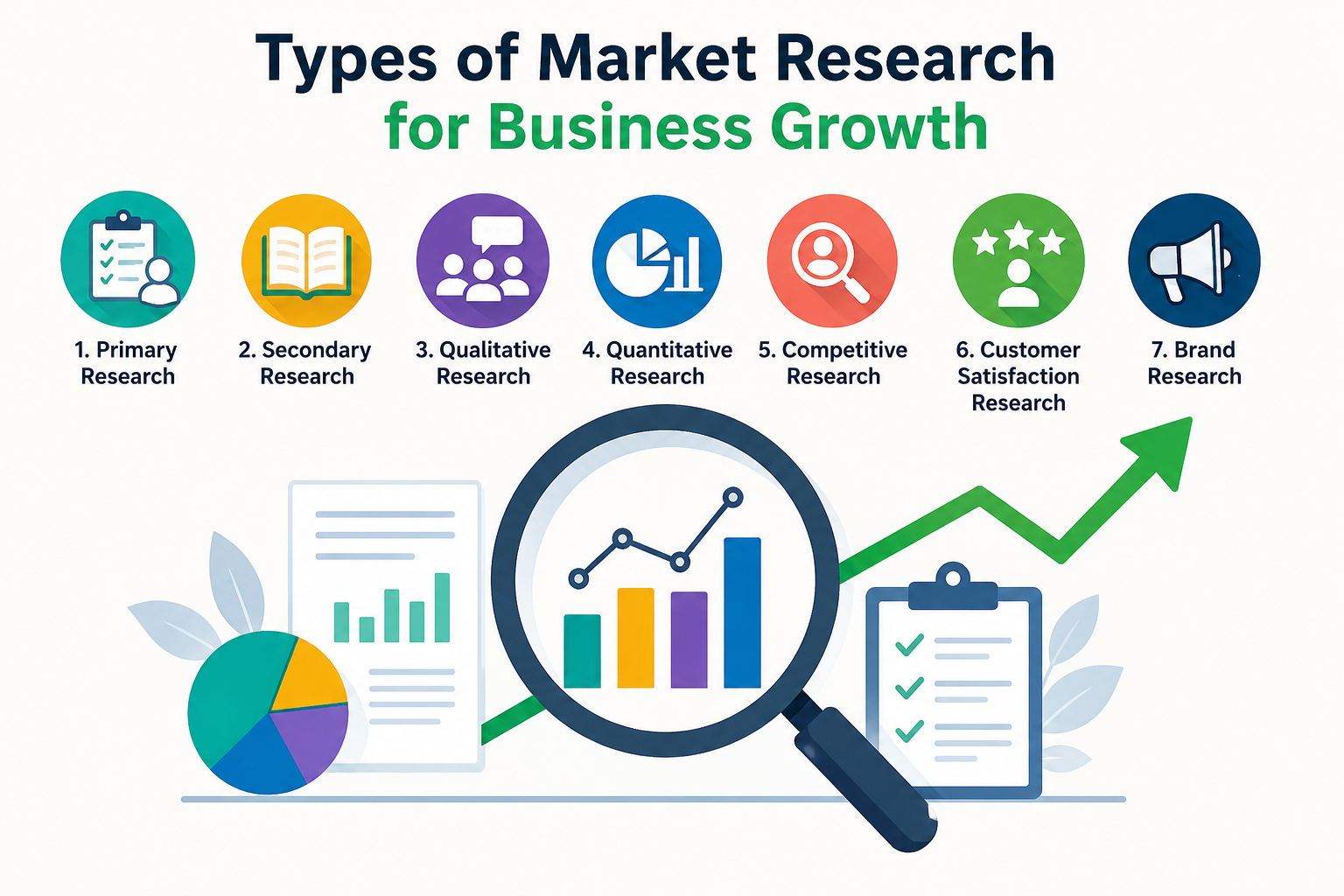
This guide explores the 7 essential types of market research, their importance, benefits, methods, and practical applications. You will also learn about qualitative market research, quantitative market research, and how companies combine both approaches for smarter business decisions.
What Is Market Research?
Market research refers to the process of collecting, analyzing, and interpreting information about customers, competitors, and industry trends. It helps businesses understand market demand, customer preferences, and potential opportunities.
The overall marketing and market research strategy allows businesses to:
- Understand customer needs
- Improve products and services
- Analyze competitors
- Identify market trends
- Reduce business risks
- Increase customer satisfaction
Businesses use different methods of market research depending on their objectives, target audience, and industry type.
Why Are Different Types of Market Research Important?
Different types of market research serve different purposes. Some research methods focus on customer opinions, while others analyze data trends or competitor performance.
The importance of market research includes:
- Better customer understanding
- Improved marketing campaigns
- Stronger product development
- Increased sales opportunities
- Data-driven business decisions
- Reduced uncertainty in investments
Without proper business market research, companies may struggle to understand market demands and lose competitive advantage.
The 7 Essential Types of Market Research
Primary Market Research
Primary research involves collecting original data directly from customers or target audiences. Businesses gather fresh information through surveys, interviews, focus groups, and observations.
Common Primary Research Methods
- Customer surveys
- One-on-one interviews
- Focus groups
- Online polls
- Product testing
- Observational research
Benefits of Primary Research
- Provides real-time customer insights
- Delivers highly relevant data
- Helps improve customer experience
- Supports product innovation
Primary research is one of the most reliable market research techniques because the information comes directly from the source.
Secondary Market Research
Secondary research uses existing information from published reports, websites, government databases, and industry studies.
If you are wondering what are secondary research methods, they include:
- Industry reports
- Research papers
- Competitor websites
- Government publications
- Online statistics databases
- Market trend reports
Benefits of Secondary Research
- Saves time and money
- Provides broad industry insights
- Helps identify market trends
- Supports competitive analysis
Businesses often combine primary and secondary research to improve the overall marketing research process.
Qualitative Market Research
Qualitative market research focuses on understanding customer opinions, motivations, emotions, and experiences. It explores why customers think or behave in a certain way.
Common Qualitative Research Methods
- Focus groups
- Customer interviews
- Open-ended surveys
- Case studies
- Ethnographic research
Benefits of Qualitative Market Research
The major benefits of qualitative market research include:
- Deeper customer understanding
- Better emotional insights
- Improved product development
- Enhanced branding strategies
Businesses use qualitative research to discover hidden customer pain points and preferences.
Example
A restaurant chain may conduct interviews to understand why customers prefer certain menu items or dining experiences.
Quantitative Market Research
Quantitative market research focuses on collecting numerical data and measurable statistics. This method helps businesses analyze patterns, trends, and behaviors on a larger scale.
Types of Quantitative Market Research
Some common types of quantitative market research include:
- Online surveys
- Structured questionnaires
- Statistical analysis
- Customer satisfaction scores
- Polls and ratings
Benefits of Quantitative Market Research
The main benefits of quantitative market research include:
- Easy data measurement
- Statistical accuracy
- Scalable research
- Faster analysis
- Better forecasting
Quantitative research is highly effective for identifying large-scale customer trends and measuring campaign performance.
Example
An eCommerce company may use quantitative surveys to measure customer satisfaction scores after product delivery.
Competitive Market Research
Competitive research analyzes competitors’ strengths, weaknesses, strategies, and customer engagement methods.
Key Areas of Competitive Research
- Pricing strategies
- Product offerings
- Customer reviews
- Social media performance
- Advertising campaigns
- SEO and content strategies
Benefits
- Identifies market gaps
- Improves competitive positioning
- Helps create better marketing strategies
- Enhances customer targeting
Competitive analysis is a vital component of successful business market research.
Customer Satisfaction Research
Customer satisfaction research measures how customers feel about products, services, and overall brand experience.
Common Methods
- Customer feedback surveys
- Net Promoter Score (NPS)
- Online reviews
- Customer support analysis
Benefits
- Improves customer loyalty
- Reduces customer churn
- Enhances product quality
- Builds stronger brand reputation
Customer satisfaction research plays a major role in improving long-term business performance.
Brand Research
Brand research evaluates how customers perceive a company, product, or service in the market.
Brand Research Areas
- Brand awareness
- Brand reputation
- Customer trust
- Brand positioning
- Advertising effectiveness
Benefits
- Strengthens brand identity
- Improves customer engagement
- Increases market visibility
- Supports marketing campaigns
Businesses use brand research to maintain consistency and build customer trust.
Qualitative and Quantitative Market Research
Many businesses combine qualitative and quantitative market research to gain a complete understanding of customer behavior.
Qualitative Research Answers:
- Why customers behave in a certain way
- What emotions influence decisions
- How customers feel about products
Quantitative Research Answers:
- How many customers prefer a product
- What percentage of customers are satisfied
- Which trends are growing faster
Combining both methods provides balanced insights for better decision-making.
Quantitative vs Qualitative Market Research
The debate around quantitative vs qualitative market research depends on business goals.
| Feature | Qualitative Research | Quantitative Research |
| Focus | Opinions & emotions | Numerical data |
| Data Type | Descriptive | Statistical |
| Sample Size | Small | Large |
| Analysis | Thematic | Mathematical |
| Goal | Explore insights | Measure trends |
Businesses often use both approaches together for stronger results.
The Marketing Research Process
The marketing research process follows several important steps:
Step 1: Define the Problem
Businesses first identify the challenge or opportunity they want to study.
Step 2: Set Research Objectives
Clear goals help determine the right research methods and data collection techniques.
Step 3: Choose Research Methods
Companies select suitable methods of market research such as surveys, interviews, or data analysis.
Step 4: Collect Data
Researchers gather information from customers, competitors, and industry sources.
Step 5: Analyze Data
Businesses interpret findings to identify patterns and opportunities.
Step 6: Implement Decisions
The final insights help improve products, marketing strategies, and customer experiences.
Common Market Research Techniques
There are several effective market research techniques businesses use today:
Surveys
Surveys help collect large amounts of customer feedback quickly.
Focus Groups
Small group discussions provide detailed customer insights.
Interviews
One-on-one interviews reveal customer motivations and emotions.
Observational Research
Researchers study customer behavior in real-world situations.
Online Analytics
Businesses analyze website traffic, social media engagement, and user behavior.
Social Media Listening
Brands monitor online conversations to understand customer opinions.
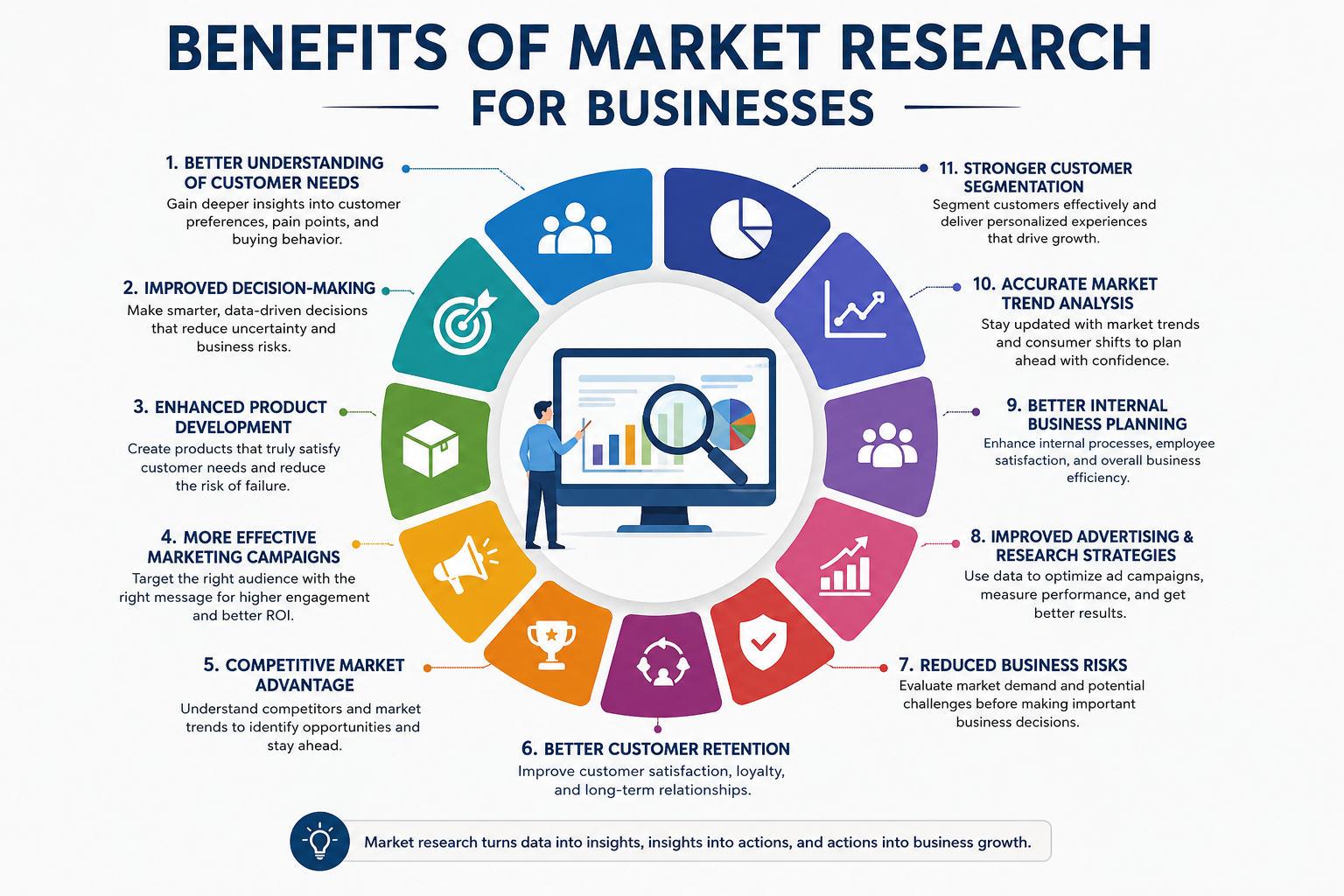
Benefits of Market Research
The overall benefits of market research extend across every business function.
Better Customer Understanding
Businesses learn customer preferences, behaviors, and expectations.
Improved Product Development
Research helps create products customers actually want.
Reduced Business Risks
Companies make more informed decisions using reliable data.
Enhanced Marketing Campaigns
Research improves targeting, messaging, and advertising effectiveness.
Stronger Competitive Advantage
Businesses stay ahead by understanding industry trends and competitor strategies.
How Companies Use Market Research
Companies across industries use research to improve performance and customer satisfaction.
Retail Industry
Retail brands study customer buying patterns and product preferences.
Technology Companies
Tech firms use research to improve user experience and product innovation.
Healthcare Sector
Healthcare providers analyze patient satisfaction and treatment outcomes.
Automotive Industry
The automotive sector increasingly relies on research to understand the future of automotive supply chain and improve automotive logistics and supply chain management systems.
Research helps automotive companies:
- Optimize production
- Improve inventory management
- Predict consumer demand
- Enhance logistics efficiency
What Tools Are Used for Market Research?
Modern market research uses advanced digital tools and platforms.
Popular Market Research Tools
- Google Analytics
- SurveyMonkey
- Qualtrics
- SEMrush
- HubSpot
- Tableau
- Hotjar
These tools help businesses collect, analyze, and visualize customer data effectively.
How Businesses Improve Customer Insights Through Research
Customer insights improve when businesses:
- Collect regular customer feedback
- Analyze behavioral data
- Monitor social media conversations
- Conduct customer interviews
- Track industry trends
- Use AI-powered analytics
Strong customer insights lead to better marketing strategies, improved products, and higher customer satisfaction.
Which Type of Market Research Is Most Effective?
There is no single best research method. The most effective types of market research depend on business goals.
Use Qualitative Research When:
- Exploring customer emotions
- Testing new ideas
- Understanding motivations
Use Quantitative Research When:
- Measuring trends
- Collecting statistical data
- Forecasting growth
Most successful businesses combine multiple research approaches for better accuracy and decision-making.
Future Trends in Market Research
Market research continues to evolve with technology and data analytics.
AI-Powered Research
Artificial intelligence improves customer behavior prediction and data analysis.
Real-Time Analytics
Businesses now track customer activity instantly.
Predictive Insights
Advanced analytics help forecast future trends and buying behaviors.
Automation
Automation reduces manual research efforts and speeds up reporting.
These innovations are shaping the future of marketing and market research globally.
FAQs About Types of Market Research
What are the main types of market research?
The main types of market research include primary research, secondary research, qualitative research, quantitative research, competitive research, customer satisfaction research, and brand research.
What is the difference between primary and secondary market research?
Primary research collects original data directly from customers, while secondary research uses existing published information from reports, websites, and databases.
Why are different types of market research important?
Different research methods help businesses understand customer behavior, market trends, competitors, and growth opportunities more effectively.
What are examples of market research methods?
Examples include surveys, interviews, focus groups, online analytics, observational studies, and customer feedback analysis.
Which type of market research is most effective?
The most effective method depends on business goals. Combining qualitative and quantitative research often provides the best results.
How do companies use market research?
Companies use research to improve products, optimize marketing strategies, understand customers, and reduce business risks.
What tools are used for market research?
Popular tools include Google Analytics, Qualtrics, SEMrush, SurveyMonkey, HubSpot, and Tableau.
How can businesses improve customer insights through research?
Businesses improve customer insights by collecting feedback, analyzing customer behavior, tracking trends, and using advanced analytics tools.
Drive Business Success with Smart Market Research
Understanding the right types of market research can transform how businesses connect with customers, improve products, and stay ahead of competitors. Whether using qualitative market research, quantitative market research, or advanced market research techniques, businesses gain valuable insights that support long-term growth.
Investing in a strong business market research strategy allows companies to make data-driven decisions, improve customer satisfaction, and identify future opportunities. By combining modern research tools with a structured marketing research process, businesses can create more effective marketing campaigns and achieve sustainable success.