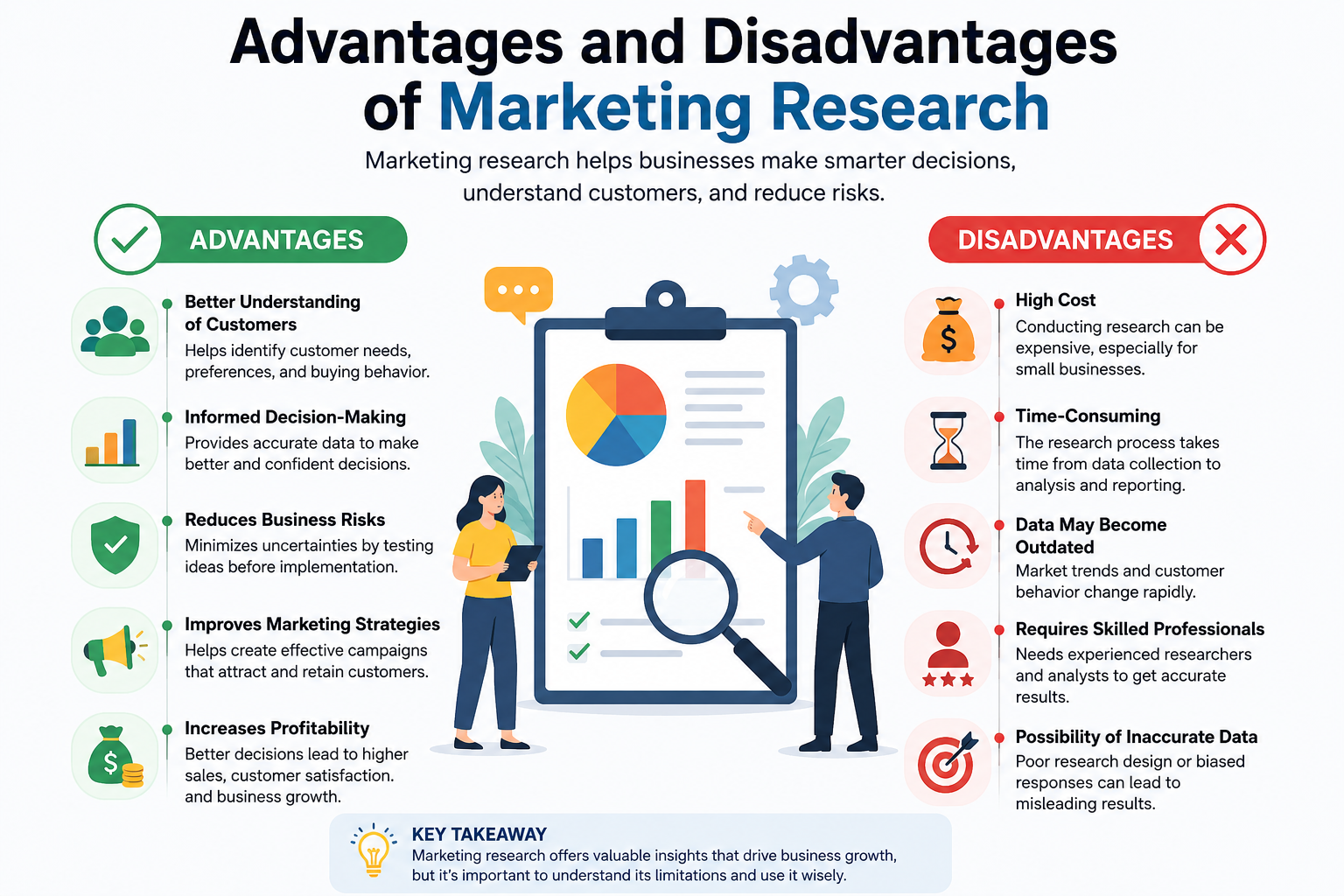
Introduction
Why do some products become instant successes while others fail despite massive advertising budgets? The answer often lies in understanding customers, market trends, and consumer behavior before making business decisions. This is where both market research and marketing research play a powerful role.
The difference between market research and marketing research is one of the most searched and misunderstood concepts in business strategy. Many people use these terms interchangeably, but they are not the same. While both help companies understand customers and improve performance, their objectives, scope, and methods are completely different.
Market research mainly focuses on studying target audiences, customer preferences, market demand, competitors, and industry trends. Marketing research is much broader and examines every aspect of marketing activities, including advertising performance, pricing strategies, branding, customer satisfaction, product development, and promotional effectiveness.
Understanding the difference between market research and marketing research helps businesses make smarter decisions, reduce risks, improve customer engagement, and create data-driven growth strategies. Modern companies rely heavily on advanced market research tools and techniques, surveys, analytics platforms, and customer behavior insights to stay ahead in rapidly changing industries.
This detailed guide explores the complete difference between market research and marketing research, including examples, methods, tools, benefits, and practical applications. You will also discover the marketing research process, the role of a marketing analyst, and how valuable marketing insights help businesses achieve long-term success.
Define Market and Marketing
Before understanding the difference between market research and marketing research, it is important to understand the meaning of market and marketing.
What Is a Market?
A market refers to a group of customers or consumers who are interested in buying products or services. It can be local, national, or global. Businesses analyze markets to identify customer needs, demand, competition, and trends.
Examples include:
- Smartphone market
- Fashion market
- Automobile market
- Digital services market
What Is Marketing?
Marketing is the process of promoting, selling, and delivering products or services to customers. It includes branding, advertising, pricing, communication, sales strategies, and customer engagement.
Marketing aims to attract customers, build loyalty, and increase revenue.
Understanding how markets work and how marketing influences consumer behavior forms the foundation of both market research marketing and marketing research activities.
What Is Market Research?
Market research is the process of collecting and analyzing information about a target market, customers, competitors, and industry trends.
The primary purpose of market research is to understand:
- Customer preferences
- Buying behavior
- Market demand
- Industry competition
- Consumer demographics
- Market opportunities
Businesses use market research methods and techniques to identify whether a product or service will succeed in the market.
Examples of Market Research
- Customer surveys
- Focus groups
- Competitor analysis
- Online polls
- Consumer interviews
- Social media feedback analysis
Companies often hire market research firms to gather detailed consumer data and provide actionable recommendations.
What Is Marketing Research?
Marketing research is a broader concept that studies every aspect of marketing activities.
It includes:
- Product research
- Pricing research
- Advertising effectiveness
- Brand perception
- Customer satisfaction
- Sales performance
- Promotional strategies
The goal of marketing research is to improve overall marketing performance and business decision-making.
Unlike market research, marketing research examines the entire marketing process rather than just the target market.
Difference Between Market Research and Marketing Research
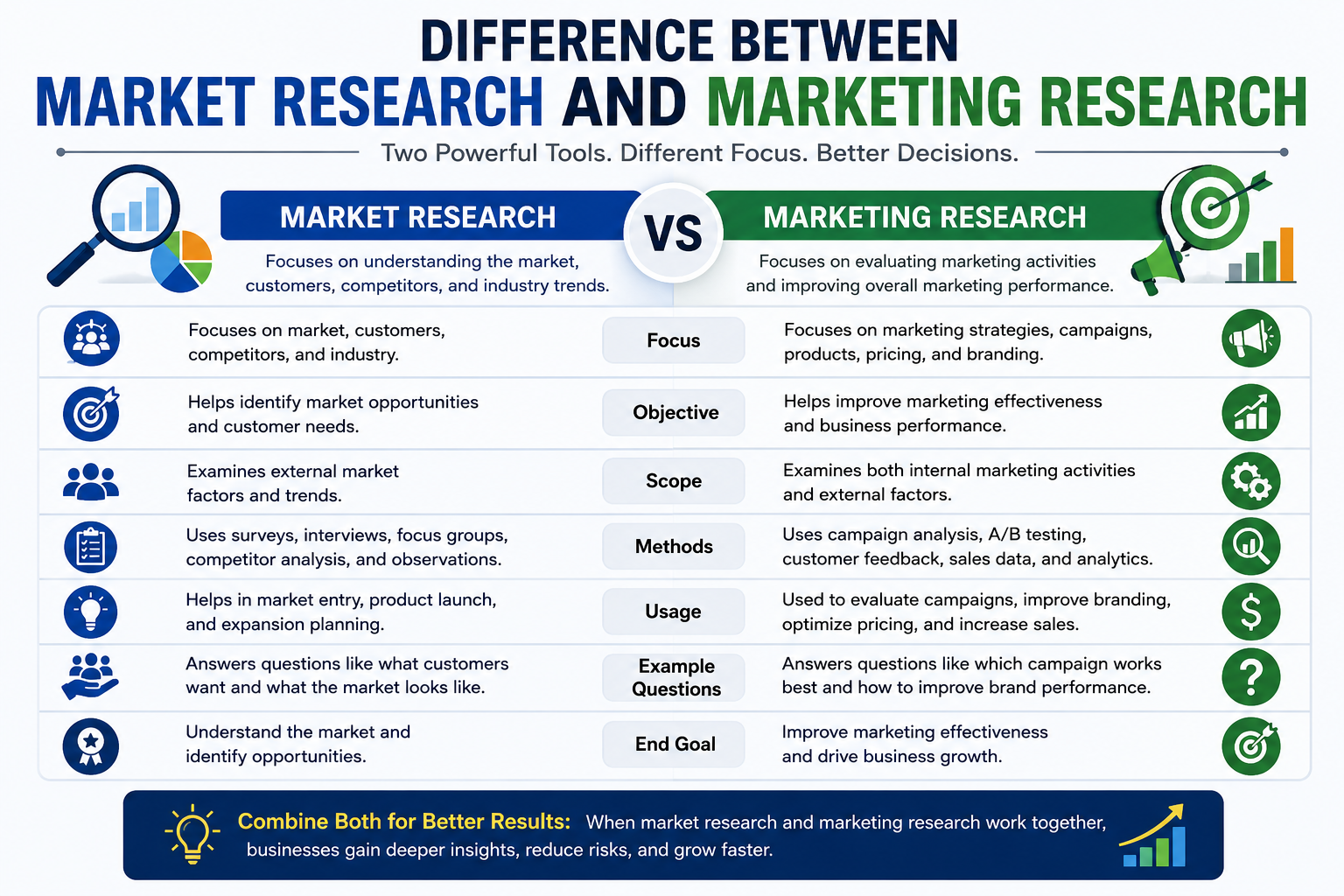
The difference between market research and marketing research lies mainly in their scope, objectives, and application. While both support business growth, they focus on different areas.
Below are the 10 major differences every business professional should know.
Scope of Research
Market Research
Market research focuses specifically on the market and target audience.
It studies:
- Customer needs
- Market size
- Industry demand
- Competitors
- Consumer behavior
Marketing Research
Marketing research has a wider scope.
It studies:
- Product performance
- Pricing strategies
- Advertising campaigns
- Distribution channels
- Branding effectiveness
- Customer satisfaction
This is one of the biggest aspects of the difference between market research and marketing research.
Primary Objective
Market Research Objective
The main goal is to understand market conditions and customer preferences.
Marketing Research Objective
The goal is to improve marketing strategies and optimize business performance.
Businesses using market research marketing strategies often combine both approaches for better outcomes.
Focus Area
Market Research Focus
Market research concentrates on external market factors.
Examples:
- Customer demand
- Competitor activity
- Market trends
Marketing Research Focus
Marketing research examines both internal and external marketing activities.
Examples:
- Campaign effectiveness
- Pricing performance
- Product positioning
Nature of Data Collection
Market Research Data
Market research gathers data directly related to customers and markets.
Methods include:
- Surveys
- Interviews
- Observations
- Focus groups
Marketing Research Data
Marketing research collects broader marketing-related information including:
- Advertising metrics
- Customer retention data
- Brand awareness reports
- Sales analytics
This highlights another important difference between market research and marketing research.
Research Scope
Market Research Is Narrow
It mainly studies the target market.
Marketing Research Is Broad
It includes all aspects of marketing activities.
This broader scope makes marketing research more comprehensive.
Decision-Making Role
Market Research Decisions
Helps businesses decide:
- Which market to target
- What customers want
- Market demand levels
Marketing Research Decisions
Helps businesses decide:
- Which marketing strategy works best
- How to improve advertising
- How to optimize pricing
Usage in Business Strategy
Market Research Usage
Used during:
- Product launch
- Market entry
- Expansion planning
Marketing Research Usage
Used continuously for:
- Campaign analysis
- Brand improvement
- Customer retention
- Performance optimization
Tools and Techniques Used
Market Research Tools and Techniques
Popular tools include:
- Online surveys
- Customer interviews
- Competitor analysis tools
- Trend analysis
- Focus groups
Marketing Research Tools and Techniques
Common methods include:
- Marketing analytics
- A/B testing
- CRM analytics
- Campaign tracking
- Brand monitoring software
Modern businesses rely heavily on advanced market research tools and techniques to gain accurate customer insights.
Type of Questions Asked
Market Research Questions
Examples:
- What do customers want?
- Which products are trending?
- Who are the competitors?
Marketing Research Questions
Examples:
- Which campaign performs best?
- Is the pricing strategy effective?
- How strong is brand awareness?
End Goal
Market Research End Goal
To understand the market and identify opportunities.
Marketing Research End Goal
To improve marketing effectiveness and maximize business growth.
This final point clearly explains the overall difference between market research and marketing research.
Difference Between Market Research and Marketing
Many people also confuse market research with marketing itself.
Marketing
Marketing involves promoting and selling products.
Market Research
Market research gathers customer and market data to support marketing decisions.
The difference between market research and marketing is simple:
- Marketing executes strategies.
- Market research provides the information needed to create those strategies.
Why Market Research Is Important for Businesses?
Market research plays a critical role in business success.
Helps Understand Customers
Businesses can identify:
- Customer preferences
- Pain points
- Buying behavior
Reduces Business Risks
Research minimizes the risk of launching unsuccessful products.
Improves Product Development
Companies create products aligned with customer needs.
Supports Better Decision-Making
Data-driven decisions are more accurate and profitable.
Enhances Competitive Advantage
Businesses stay ahead by understanding competitors and industry trends.
This is why many companies invest heavily in professional market research firms.
What Are the Marketing Research Activities?
Marketing research includes several important activities that improve marketing performance.
Product Research
Analyzing customer feedback and product demand.
Pricing Research
Determining the best pricing strategy.
Advertising Research
Measuring campaign effectiveness.
Brand Research
Studying customer perception and brand awareness.
Customer Satisfaction Research
Understanding customer experiences and loyalty.
Sales Analysis
Evaluating sales performance and market response.
These activities help businesses generate powerful marketing insights for strategic planning.
Market Research Methods and Techniques
Businesses use multiple market research methods and techniques to collect accurate data.
Surveys
Online and offline surveys gather customer opinions quickly.
Interviews
Direct interviews provide detailed insights into customer behavior.
Focus Groups
Small groups discuss products, services, or campaigns.
Observation Research
Researchers observe customer behavior in real environments.
Competitor Analysis
Businesses analyze competitors’ strengths and weaknesses.
Social Media Monitoring
Brands study online conversations and customer feedback.
Data Analytics
Advanced analytics tools identify patterns and trends.
These modern market research tools and techniques help companies make informed decisions.
Marketing Research Process Explained
The marketing research process follows a structured approach.
Step 1: Identify the Problem
Businesses first define the issue or objective.
Example:
- Low sales
- Weak customer engagement
- Poor campaign performance
Step 2: Define Research Objectives
Companies determine what information they need.
Step 3: Develop Research Plan
Researchers choose suitable methods and data sources.
Step 4: Collect Data
Data may be collected through:
- Surveys
- Interviews
- Analytics tools
- Customer feedback
Step 5: Analyze Data
Researchers interpret the findings.
Step 6: Present Insights
Reports and recommendations are shared with decision-makers.
Step 7: Implement Decisions
Businesses use the findings to improve strategies.
A strong marketing research process helps organizations improve performance and customer satisfaction.
Role of a Marketing Analyst
A marketing analyst is responsible for studying market trends, customer behavior, and marketing performance.
Main Responsibilities
- Analyze customer data
- Monitor campaign performance
- Study competitors
- Create reports
- Generate marketing insights
- Support business decisions
Skills Required
- Data analysis
- Communication
- Research skills
- Critical thinking
- Digital analytics knowledge
Modern businesses rely heavily on skilled marketing analysts to stay competitive.
Importance of Marketing Insights
Marketing insights are valuable findings derived from research and data analysis.
Benefits of Marketing Insights
Better Customer Understanding
Businesses understand customer expectations more effectively.
Improved Campaign Performance
Companies optimize campaigns based on real data.
Increased ROI
Research-driven marketing improves returns on investment.
Stronger Customer Relationships
Brands build trust and loyalty through personalized experiences.
Smarter Business Decisions
Insights reduce guesswork and improve planning.
This is why marketing insights are considered essential in modern business strategy.
Market Research Firms and Their Importance
Many businesses hire professional market research firms for expert analysis.
What Do Market Research Firms Do?
They provide:
- Consumer research
- Competitor analysis
- Brand studies
- Industry reports
- Customer behavior analysis
Benefits of Hiring Market Research Firms
Access to Expert Knowledge
Experienced researchers provide accurate insights.
Advanced Research Tools
Professional firms use sophisticated research technologies.
Time-Saving
Businesses can focus on core operations.
Better Accuracy
Expert researchers deliver reliable findings.
Global brands frequently collaborate with market research firms to improve strategy and growth.
Market Research Marketing Strategies for 2026
Modern businesses use integrated market research marketing strategies to stay competitive.
AI-Powered Analytics
Artificial intelligence helps analyze customer behavior faster.
Predictive Analytics
Businesses predict future trends using data models.
Personalized Marketing
Research helps create customized customer experiences.
Real-Time Consumer Tracking
Brands monitor customer behavior instantly.
Voice of Customer Programs
Companies collect ongoing customer feedback.
Social Listening
Businesses track social media discussions to understand market trends.
These advanced methods are transforming both market research and marketing research in 2026.
Common Mistakes Businesses Make
Even experienced companies sometimes misunderstand the difference between market research and marketing research.
Ignoring Customer Feedback
Businesses fail when they ignore customer needs.
Relying on Assumptions
Decisions without research increase risks.
Using Outdated Data
Old research leads to poor strategies.
Poor Data Analysis
Collecting data without proper interpretation limits effectiveness.
Confusing Market Research With Marketing Research
Many businesses use the terms interchangeably, which creates strategic confusion.
Understanding the true difference between market research and marketing research helps avoid these mistakes.
How Businesses Can Use Both Research Types Together
The best companies combine market research and marketing research.
Example
Market Research Helps Identify
- Customer demand
- Market gaps
- Industry opportunities
Marketing Research Helps Improve
- Campaign performance
- Pricing
- Customer engagement
- Branding
Using both together creates stronger business strategies and better results.
Future Trends in Market and Marketing Research
The future of research is becoming more technology-driven.
AI and Automation
AI tools will automate data collection and analysis.
Behavioral Analytics
Businesses will study customer behavior more deeply.
Predictive Customer Modeling
Companies will forecast future buying behavior.
Real-Time Analytics
Businesses will receive instant research insights.
Hyper-Personalization
Research data will improve personalized marketing experiences.
The growing importance of marketing insights will continue shaping modern business strategies.
Market Research Marketing Strategies for Business Growth
Understanding the difference between market research and marketing research helps businesses make smarter decisions, improve customer understanding, and strengthen marketing performance. While market research focuses on customer behavior and market trends, marketing research improves advertising, branding, pricing, and overall business strategies.
Modern businesses use advanced market research marketing strategies, AI-powered analytics, and customer insights to identify opportunities and reduce risks. Companies that invest in both market research and marketing research build stronger customer relationships and achieve long-term growth.
If you want to improve your business strategy and make data-driven decisions, start leveraging smarter research solutions with ResearchFox today.
Frequently Asked Questions:
What is the difference between market research and marketing research?
The main difference between market research and marketing research is scope. Market research focuses specifically on customers, target markets, competitors, and industry trends. Marketing research is broader and includes every aspect of marketing activities such as pricing, branding, advertising, product performance, and customer satisfaction. Market research helps businesses understand the market, while marketing research helps improve overall marketing effectiveness and business growth.
Why is market research important for businesses?
Market research helps businesses understand customer behavior, identify market opportunities, reduce risks, and improve decision-making. It allows companies to develop products and services that match customer needs. Businesses also use market research to analyze competitors, track industry trends, and improve customer satisfaction. Without proper research, companies often make decisions based on assumptions rather than real data.
What are the marketing research activities?
Marketing research activities include product research, advertising research, pricing analysis, customer satisfaction studies, brand perception analysis, sales evaluation, and competitor analysis. These activities help businesses measure marketing performance, improve campaigns, optimize strategies, and generate valuable marketing insights for long-term growth.
What are the best market research tools and techniques?
Some of the best market research tools and techniques include surveys, focus groups, interviews, social media monitoring, competitor analysis, data analytics, observation research, and online polling tools. Modern businesses also use AI-powered analytics platforms and customer feedback systems to gain deeper insights into consumer behavior and market trends.
What is the role of a marketing analyst?
A marketing analyst studies market trends, customer data, and campaign performance to help businesses make better decisions. They analyze consumer behavior, evaluate competitor strategies, create reports, and provide recommendations for improving marketing effectiveness. Marketing analysts play a major role in generating actionable marketing insights for business growth.
How does marketing research improve business growth?
Marketing research improves business growth by helping companies understand customer needs, optimize marketing campaigns, improve products, and strengthen branding strategies. It reduces uncertainty, increases customer satisfaction, and improves return on investment. Businesses that use strong marketing research strategies often achieve better customer engagement and long-term profitability.
What is the marketing research process?
The marketing research process involves identifying a business problem, defining research objectives, creating a research plan, collecting data, analyzing information, presenting findings, and implementing decisions. This structured process helps businesses make data-driven decisions and improve marketing performance effectively.
What is the difference between market research and marketing?
The difference between market research and marketing is that marketing focuses on promoting and selling products or services, while market research focuses on gathering customer and market information to support those marketing efforts. Marketing executes strategies, whereas market research provides the insights needed to build effective strategies.