Introduction
Every successful business decision begins with one thing: understanding people correctly.
Companies often assume they know what customers want, but assumptions can become expensive mistakes. Products fail, campaigns underperform, and customer engagement drops when decisions are made without reliable data. That is why businesses increasingly rely on market research methodologies to reduce uncertainty and improve decision-making.
The challenge is not just collecting information. The real challenge is collecting the right information in the right way.
Strong market research methodologies help businesses uncover hidden customer behaviors, predict trends, improve products, and identify new opportunities before competitors do. Whether you are running a startup, managing a healthcare company, or leading enterprise growth strategies, choosing the right research method directly impacts your results.
This guide explores 15 proven market research methodologies that help brands generate more accurate market insights, improve market research and analysis, and build stronger customer-focused strategies.
What Are Market Research Methodologies?
Market research methodologies refer to structured approaches used to collect, analyze, and interpret data about customers, competitors, and the overall market.
These methodologies help businesses:
- Understand customer needs
- Identify trends
- Test ideas
- Improve products and services
When applied correctly, they transform raw data into meaningful market insights that guide smarter strategies.
Why Market Research Methodologies Matter?
Without a clear methodology, research becomes guesswork. Using the right market research methodologies ensures:
- Better accuracy in findings
- Stronger alignment with business goals
- Deeper understanding of the market research for target audience
- Improved ROI from marketing efforts
In short, they are the foundation of effective market research and analysis.
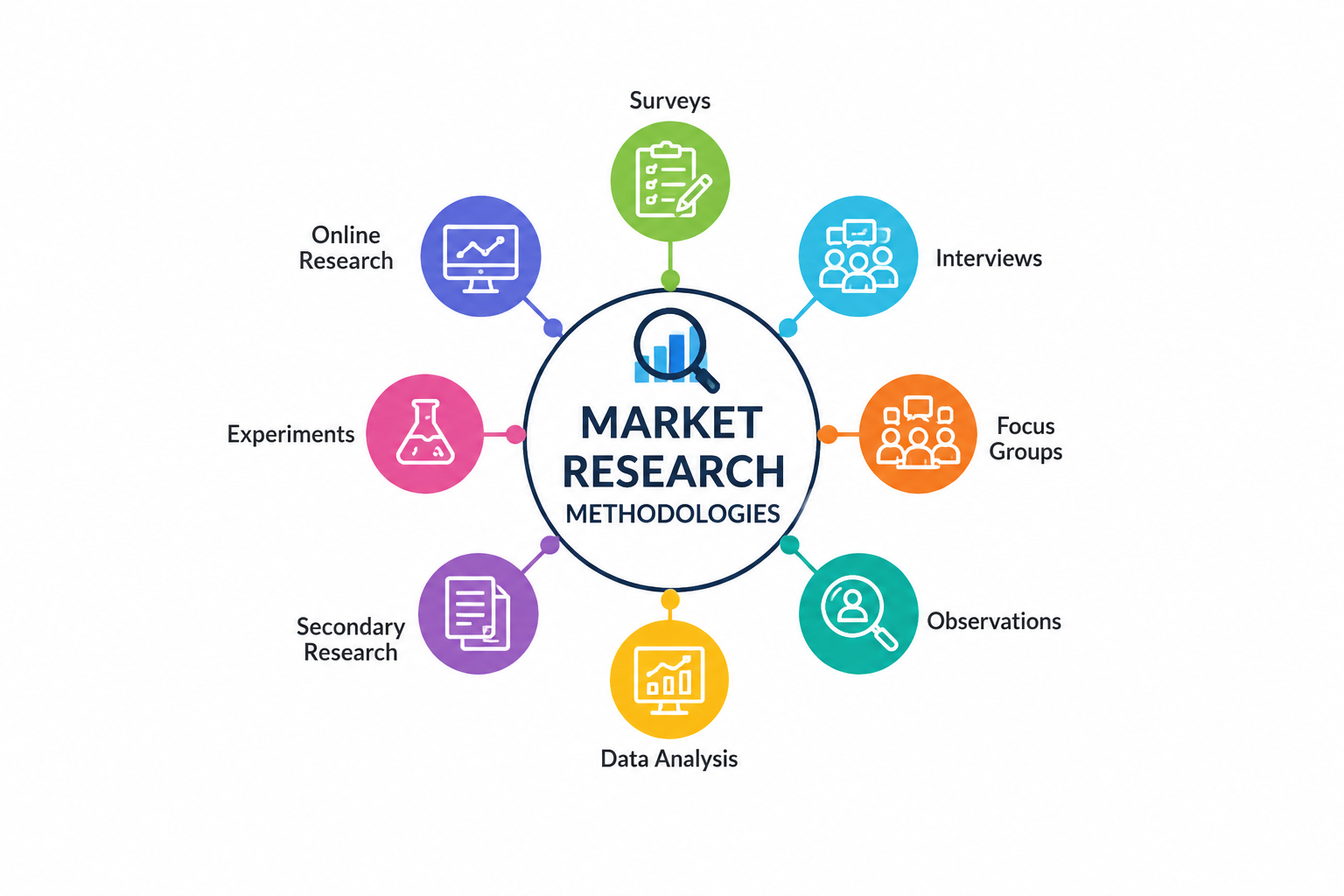
15 Powerful Market Research Methodologies
Let’s explore the most effective types of market research that deliver reliable results.
1. Surveys (Quantitative Research)
Surveys are one of the most widely used market research methodologies.
They allow businesses to collect structured data from a large audience quickly.
Why it works:
- Easy to scale
- Provides measurable data
- Ideal for target market research
2. In-Depth Interviews
This method focuses on one-on-one conversations to explore opinions, emotions, and motivations.
Best for:
- Understanding customer behavior
- Generating detailed market research insights
3. Focus Groups
Focus groups bring together a small group of people to discuss a product, service, or idea.
Key benefit:
You can observe group dynamics and uncover deeper consumer insights vs market research differences.
4. Observational Research
Instead of asking customers what they do, this method studies what they actually do.
Why it matters:
Behavior often reveals more than words, making it essential for accurate market insights.
5. Experiments and A/B Testing
This approach tests different versions of a product, ad, or feature to find out which one people respond to the most.
Use case:
- Testing pricing strategies
- Improving marketing techniques
6. Secondary Data Analysis
This involves analyzing existing reports, studies, and data sources.
Advantage:
- Cost-effective
- Fast insights
It complements primary market research for a complete picture.
7. Social Media Listening
Tracking conversations on social platforms provides real-time market insights.
Benefits:
- Understand trends
- Monitor brand perception
- Identify customer sentiment
8. Customer Journey Mapping
This method tracks every step a customer takes from awareness to purchase.
Why it’s powerful:
It improves market research for target audience by identifying pain points.
9. Ethnographic Research
This approach involves studying customers in their natural environment.
Key outcome:
Deep emotional and cultural understanding of behavior.
10. Online Analytics Research
Using tools like website analytics to track user behavior.
Helps with:
- Improving user experience
- Enhancing market research and analysis
11. Competitive Analysis
Studying competitors helps identify strengths, weaknesses, and opportunities.
Role in business:
Essential for strategic business and market research.
12. Concept Testing
Before launching a product, businesses test ideas with their audience.
Result:
Better product-market fit and stronger market research insights.
13. Panel Research
This involves collecting data from the same group over time.
Advantage:
Tracks changes in behavior and preferences.
14. Mobile Research
With increasing smartphone usage, mobile-based research is becoming essential.
Why it’s trending:
- Quick responses
- Real-time feedback
15. AI-Powered Research
Artificial intelligence is transforming market research methodologies.
Key benefits:
- Faster data processing
- Predictive market insights
- Automation of analysis
Types of Market Research Explained
Understanding different types of market research helps you choose the right approach:
Primary Market Research
Collecting data directly from customers through surveys, interviews, etc.
Secondary Research
Using existing data sources like reports and studies.
Qualitative Research
Focuses on opinions, feelings, and motivations.
Quantitative Research
Focuses on numbers and measurable data.
Combining these types leads to stronger market research insights.
Market Research for Target Audience
Effective market research for target audience helps businesses:
- Identify ideal customers
- Understand needs and preferences
- Personalize marketing strategies
Without proper target market research, even the best products may fail.
Marketing Research Process: Step-by-Step
A structured marketing research process ensures reliable outcomes:
1. Define the Problem
Clearly identify what you want to learn.
2. Choose Methodology
Select the right market research methodologies.
3. Collect Data
Use surveys, interviews, or analytics.
4. Analyze Data
Convert raw data into meaningful market insights.
5. Take Action
Use findings to improve business decisions.
Market Research Trends in 2026
The world of research is evolving rapidly. Here are key market research trends:
1. AI and Automation
AI is enhancing speed and accuracy.
2. Real-Time Data Collection
Businesses now rely on instant feedback.
3. Personalization
Customized research for better market insights.
4. Voice and Video Research
More engaging ways to collect data.
5. Privacy-Focused Research
Ethical data collection is becoming critical.
Market Research and Analysis: Turning Data into Strategy
Collecting data is only half the job. The real value comes from market research and analysis.
Key steps:
- Identify patterns
- Compare data sets
- Interpret findings
- Make data-driven decisions
Strong analysis transforms raw data into actionable market research insights.
Consumer Insights vs Market Research
Many people confuse these terms.
Consumer Insights
Focus on understanding customer emotions and behavior.
Market Research
Covers a broader scope including competitors, trends, and industry data.
Both are essential for building effective strategies.
How to Choose the Right Market Research Methodology
Not every method works for every situation.
Consider:
- Your research goal
- Budget and timeline
- Type of data needed
- Target audience
Using the right market research methodologies ensures better results and more accurate market insights.
Frequently Asked Questions:
What are market research methodologies?
Market research methodologies are structured approaches used to collect and analyze data about customers, competitors, and markets. These methods help businesses generate reliable market insights, improve strategies, and make informed decisions based on real data rather than assumptions.
Why are market research methodologies important?
They ensure accuracy and consistency in research. Without proper market research methodologies, data can be misleading, resulting in poor decisions. A structured approach improves the effectiveness of business and market research.
What are the most effective types of market research?
The most effective types of market research include surveys, interviews, focus groups, and observational studies. Combining multiple methods often produces the best market research insights.
How does market research help target audiences?
Market research for target audience helps businesses understand customer needs, preferences, and behavior. This allows for more personalized marketing and better product development.
What is the marketing research process?
The marketing research process involves defining objectives, selecting methodologies, collecting data, analyzing results, and applying insights to decision-making.
What are current market research trends?
Key market research trends include AI-driven analysis, real-time data collection, personalization, and increased focus on data privacy.
What is the difference between consumer insights and market research?
Consumer insights vs market research differs in scope. Consumer insights focus on understanding behavior and emotions, while market research includes broader analysis of the entire market.
How can businesses improve market research accuracy?
Businesses can improve accuracy by using multiple market research methodologies, asking unbiased questions, and focusing on high-quality market research and analysis.
Conclusion
Choosing the right market research methodologies can be the difference between guessing and knowing.
From surveys to AI-powered tools, each method plays a unique role in uncovering valuable market insights. When combined with a structured marketing research process, these methodologies help businesses understand their audience, adapt to trends, and stay ahead of the competition.
In a world where data drives success, mastering market research methodologies is no longer optional, it’s essential.
For advanced strategies and expert-driven solutions, explore ResearchFox to elevate your business and market research approach.