Advantages and Disadvantages of Marketing Research
Understanding the advantages and disadvantages of marketing research has become essential for businesses that want to make better decisions and improve long-term growth. Companies today rely heavily on customer data, consumer behavior analysis, and market trends to stay competitive. Without proper research, businesses may struggle to understand what customers want, how competitors operate, and which strategies actually work.
Marketing research helps organizations gather useful information about products, pricing, advertising, customer satisfaction, and buying behavior. It supports smarter business decisions and reduces uncertainty. However, despite its many benefits, there are also several challenges and limitations businesses should understand before investing heavily in research activities.
This guide explains the advantages and disadvantages of marketing research, its importance, features, methods, limitations, and practical applications in modern business.
What Is Marketing Research?
Marketing research is the process of collecting, analyzing, and interpreting information related to customers, competitors, products, and market conditions. It helps businesses understand what consumers want and how they respond to products, services, and marketing campaigns.
In simple words, marketing research allows companies to reduce uncertainty and make better business decisions using data instead of assumptions.
Importance of Marketing Research
The importance of marketing research has increased significantly in recent years because customer expectations and market conditions change rapidly.
Why Marketing Research Matters?
- Helps businesses understand customer needs
- Improves product development
- Supports pricing decisions
- Identifies new market opportunities
- Reduces business risks
- Enhances customer satisfaction
- Improves advertising performance
The importance of market research becomes even more critical when businesses enter new markets or launch new products.
Features of Marketing Research
Understanding the features of marketing research helps businesses use research more effectively.
Major Features of Marketing Research
Systematic Process
Marketing research follows a structured process involving data collection, analysis, interpretation, and reporting.
Objective-Oriented
Every research project focuses on solving a specific business problem or identifying opportunities.
Data-Driven
Research relies on real data instead of assumptions or guesses.
Continuous Process
Marketing research is not a one-time activity. Businesses continuously monitor customer behavior and market changes.
Decision Support Tool
One of the most important features of marketing research is helping businesses make informed decisions.
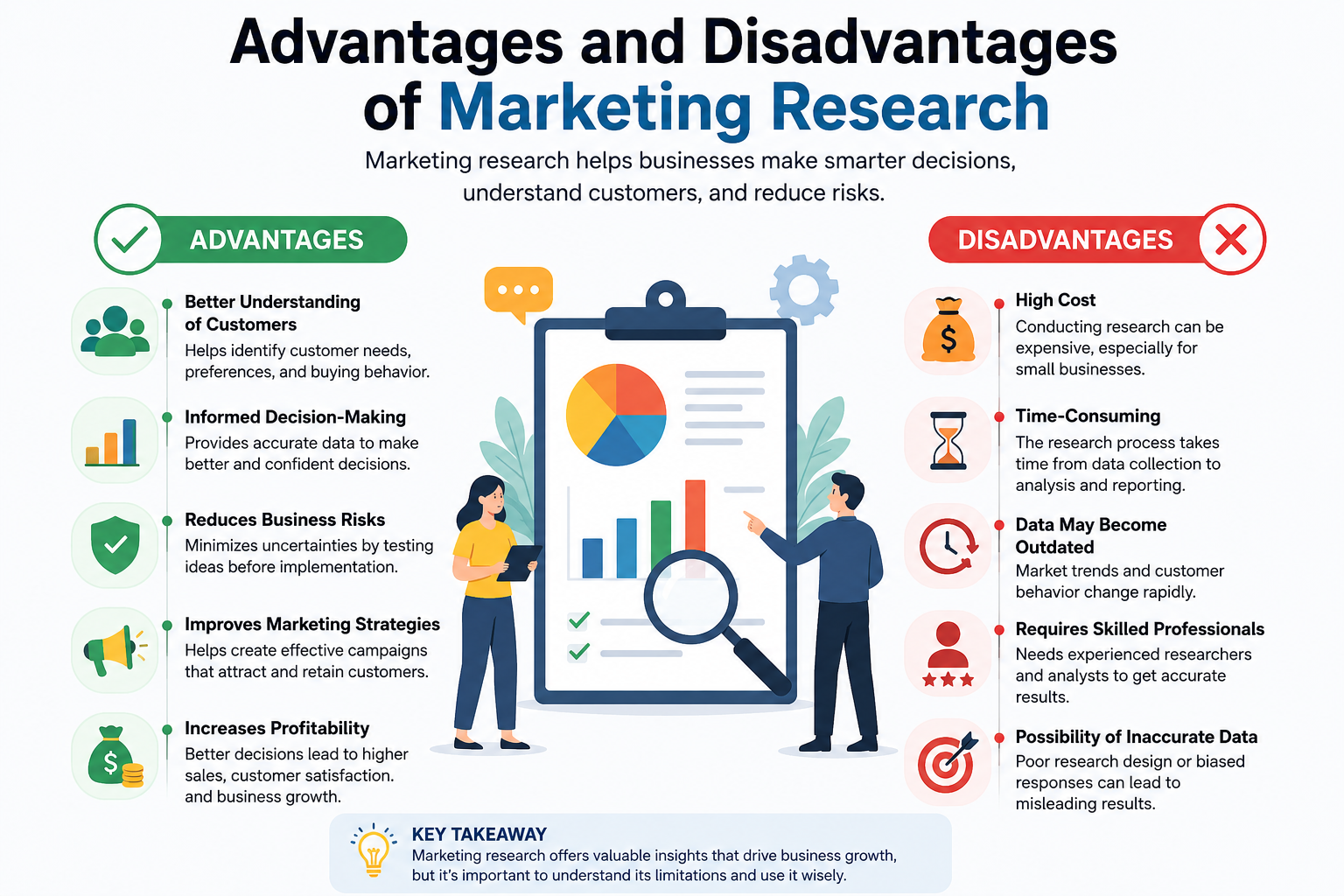
11 Major Advantages of Marketing Research
Understanding the advantages and disadvantages of marketing research starts with recognizing its benefits.
Better Understanding of Customers
Marketing research helps businesses understand:
- Customer preferences
- Buying behavior
- Pain points
- Expectations
This improves customer satisfaction and loyalty.
Reduced Business Risks
One of the biggest advantages and disadvantages of marketing research discussions focuses on risk reduction.
Research helps businesses avoid costly mistakes by testing ideas before launching products.
Improved Product Development
Companies use customer feedback and surveys to improve product quality and features.
This is one of the key reasons behind the importance of market research in modern business.
Competitive Advantage
Research helps businesses analyze competitors, identify gaps, and create better strategies.
Better Marketing Strategies
Marketing research improves:
- Advertising campaigns
- Content marketing
- Social media strategies
- Branding decisions
This highlights the importance of marketing to a business.
Accurate Pricing Decisions
Pricing products incorrectly can reduce profits.
Marketing research helps companies identify:
- Customer willingness to pay
- Competitor pricing
- Market demand
Improved Customer Satisfaction
Customer feedback helps businesses improve services and products continuously.
Helps Identify Market Trends
Research enables businesses to stay updated with changing consumer preferences and industry trends.
Supports Business Expansion
Research helps companies identify profitable locations, customer demographics, and expansion opportunities.
Better Decision-Making
One of the biggest advantages and disadvantages of marketing research is that it improves decision-making while requiring time and investment.
Data-driven decisions are more reliable than assumptions.
Enhances Profitability
Businesses using effective research strategies often improve:
- Sales performance
- Customer retention
- Brand reputation
- Revenue growth
7 Major Disadvantages of Marketing Research
Although research offers many benefits, businesses must also understand the challenges.
High Costs
One of the most common marketing research disadvantages is cost.
Research activities such as surveys, interviews, focus groups, and data analysis can be expensive.
Time-Consuming Process
Marketing research often requires weeks or months to complete.
This can delay important business decisions.
Data Can Become Outdated Quickly
Customer behavior and market conditions change rapidly.
Research findings may lose relevance over time.
Possibility of Incorrect Data
Poor survey design or biased responses can lead to inaccurate results.
Requires Skilled Professionals
Experienced researchers and analysts are needed to collect and interpret data effectively.
This increases operational costs.
Limited Predictability
Even accurate research cannot guarantee future customer behavior.
Markets are constantly evolving.
Information Overload
Businesses sometimes collect too much data without clear objectives, making analysis difficult.
This is one of the lesser-discussed limitations of marketing research.
Pros and Cons of Marketing Research
Pros of Marketing Research
- Better customer understanding
- Improved decision-making
- Reduced risks
- Stronger marketing strategies
- Competitive advantage
Cons of Marketing Research
- Expensive process
- Time-consuming
- Data may become outdated
- Requires expertise
- Results may not always be accurate
Understanding these pros and cons of marketing research helps businesses balance investment and outcomes effectively.
Types of Marketing Research Methods
Businesses use different methods depending on objectives and budgets.
Primary Research
Primary research involves collecting original data directly from customers.
Examples:
- Surveys
- Interviews
- Focus groups
- Observations
Secondary Research
Secondary research uses existing data from reports, websites, government publications, and industry studies.
Advantages of Secondary Market Research
The advantages of secondary market research include:
- Lower costs
- Faster data collection
- Easy access to information
- Useful industry insights
Qualitative Research
Focuses on customer opinions, emotions, and experiences.
Quantitative Research
Uses numerical data and statistics for analysis.
Advantages of Primary Data in Marketing Research
The advantages of primary data in marketing research include accuracy, relevance, and customization.
Key Benefits
- Specific to business objectives
- Updated and current data
- Greater control over research methods
- More reliable for decision-making
Primary research is especially useful when businesses need customized insights.
Market Research Methods and Techniques
Modern businesses use several market research methods and techniques to understand consumers.
Common Methods Include
Surveys
One of the most popular methods for collecting customer opinions.
Focus Groups
Small group discussions used to gather detailed feedback.
Interviews
Direct conversations with customers or industry experts.
Observations
Studying customer behavior in real-world environments.
Online Analytics
Tracking website traffic, user behavior, and engagement metrics.
These market research methods and techniques help businesses make smarter marketing decisions.
Market Research Tools and Techniques
Technology has transformed the way companies conduct research.
Popular Market Research Tools and Techniques
- Google Trends
- SurveyMonkey
- SEMrush
- Google Analytics
- CRM platforms
- Social media analytics tools
- AI-based customer insight tools
Using effective market research tools and techniques improves data accuracy and efficiency.
Marketing Research Process Explained
The marketing research process involves several stages.
Step 1: Identify the Problem
Businesses define the challenge or opportunity.
Step 2: Set Research Objectives
Clear goals help researchers focus on relevant data.
Step 3: Collect Data
Researchers gather primary or secondary data.
Step 4: Analyze Data
Collected information is interpreted using analytical methods.
Step 5: Present Findings
Insights and recommendations are shared with decision-makers.
Step 6: Implement Decisions
Businesses apply research findings to improve strategies.
A structured marketing research process ensures reliable and actionable insights.
Importance of Marketing to a Business
The importance of marketing to a business goes beyond promotion.
Marketing helps businesses:
- Build brand awareness
- Attract customers
- Increase sales
- Improve customer relationships
- Strengthen market positioning
Marketing research supports all these activities by providing valuable insights.
Role of Marketing Insights in Business Growth
Strong marketing insights help companies understand:
- Customer behavior
- Market trends
- Competitor strategies
- Product performance
Businesses that leverage marketing insights can adapt quickly and maintain a competitive advantage.
How Market Research Firms Help Businesses
Professional market research firms help organizations collect and analyze data more effectively.
Services Offered by Market Research Firms
- Customer surveys
- Competitor analysis
- Brand research
- Product testing
- Consumer trend analysis
Large companies often partner with market research firms for expert-level research and industry insights.
Why Small Businesses Need Marketing Research?
Many small businesses assume research is only for large corporations. However, understanding the advantages and disadvantages of marketing research is equally important for startups and local businesses.
Research helps small businesses:
- Understand customer needs
- Improve products
- Compete effectively
- Reduce financial risks
- Create better marketing strategies
Even low-cost research methods can provide valuable business insights.
Common Mistakes Businesses Make in Marketing Research
Poor Research Objectives
Without clear goals, research results become ineffective.
Ignoring Customer Feedback
Businesses sometimes collect feedback but fail to implement changes.
Using Outdated Data
Old information can lead to poor decisions.
Small Sample Sizes
Limited responses reduce accuracy.
Overcomplicating Research
Simple and focused research often produces better results.
Avoiding these mistakes improves research effectiveness significantly.
Future Trends in Marketing Research
The future of marketing research is becoming increasingly technology-driven.
Emerging Trends
- AI-powered customer analysis
- Predictive analytics
- Real-time consumer insights
- Voice and sentiment analysis
- Big data integration
Businesses adopting these technologies gain faster and more accurate insights.
Importance of Market Research: Turn Customer Insights Into Business Growth
In today’s competitive business world, companies that truly understand their customers are the ones that grow faster, market smarter, and stay ahead of competitors. This is where the importance of market research becomes impossible to ignore.
Although there are some limitations of marketing research, the benefits often outweigh the challenges when businesses use the right strategies, tools, and data analysis methods. Companies that invest in proper research are better prepared to adapt to changing customer expectations and market trends.
If you want to improve your business strategy, customer understanding, and overall growth through better market research methods and techniques, staying updated with industry insights and research trends is extremely important. Platforms like ResearchFox help businesses explore valuable research-driven strategies, consumer insights, and practical marketing knowledge to stay competitive in today’s fast-changing market.
The growing importance of market research means businesses can no longer rely only on assumptions or traditional decision-making methods. Companies that continuously study customer needs, competitor activities, and market trends are more likely to achieve sustainable growth and stronger customer loyalty. Investing in research-driven strategies today helps businesses build smarter marketing campaigns, improve customer experiences, and stay ahead in competitive industries.
Frequently Asked Questions:
Why is it important to carry out market research?
It is important to carry out market research because it helps businesses understand customer needs, market trends, and competitor strategies. Research reduces risks and supports better business decisions by providing accurate and reliable information.
What are the advantages and disadvantages of marketing research?
The main advantages include better decision-making, reduced business risks, improved customer understanding, and stronger marketing strategies. The disadvantages include high costs, time-consuming processes, and possible data inaccuracies.
What is the importance of marketing research?
The importance of marketing research lies in its ability to help businesses understand customer behavior, improve products, optimize marketing campaigns, and identify growth opportunities.
What are the types of marketing research methods?
The major types of marketing research methods include primary research, secondary research, qualitative research, and quantitative research.
What are the limitations of marketing research?
Some major limitations of marketing research include high costs, rapidly changing market conditions, unreliable responses, and dependence on data quality.
What are the features of marketing research?
The main features of marketing research include systematic data collection, objective analysis, decision-oriented processes, continuous improvement, and customer-focused insights.

ResearchFox Team
ResearchFox Team brings together market researchers, analysts and editors who create evidence-led content on consumer research, B2B research, customer experience and business strategy. The team draws on ResearchFox’s experience supporting brands, startups and enterprises across India, Dubai and international markets.