

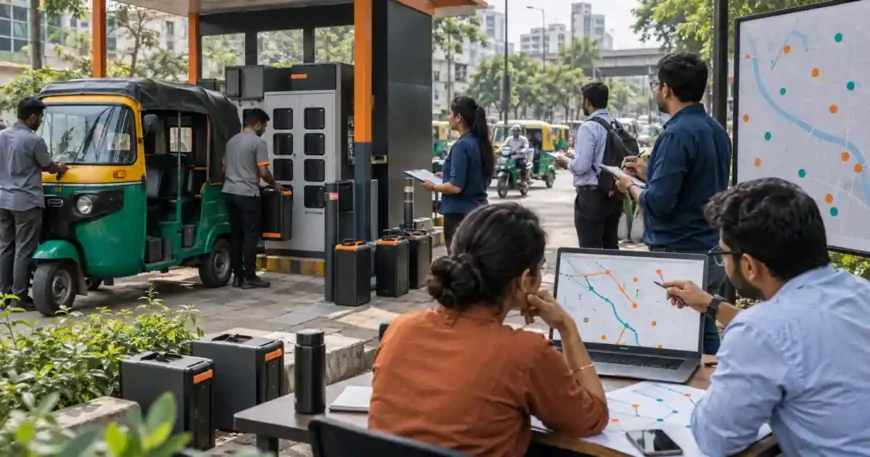
A battery swapping station can be technically suitable and still struggle commercially. The site may have adequate space and power but sit outside normal rider routes, create unsafe access, face weak demand at operating hours or attract users whose vehicles are not compatible.
Site selection therefore requires more than traffic counts or available real estate. Market research connects mobility patterns, user behaviour, fleet operations, competition and unit economics so operators can identify where swapping solves a repeated problem.
Why Location Determines Battery-swapping Adoption
Battery swapping reduces charging downtime, but users will adopt it only when the network fits their routines. A station that requires a long detour may erase the time advantage. A high-traffic road may look attractive yet perform poorly if parking, turning access or queue management is difficult.
The decision should balance:
- Concentration of compatible electric vehicles
- Frequency and timing of energy demand
- Rider routes and acceptable detour
- Fleet parking and operating patterns
- Road visibility and safe access
- Proximity to demand generators
- Power, space and operational feasibility
- Competitor and charging alternatives
- Expected transactions and site cost
No single variable is enough. The best site is the one where demand, convenience and operating feasibility intersect.
A 7-step Site Selection Research Framework
1. Define the operating model
Clarify the vehicles, customers and service model before comparing locations. A network serving delivery riders requires different locations and hours than one supporting passenger autos or captive fleets.
Record battery standards, swap time, inventory needs, staffing, operating hours, service radius and partnership assumptions. These determine which sites are feasible.
2. Estimate addressable demand
Map the number and type of compatible vehicles, daily distance travelled, energy consumption, charging alternatives and expected swap frequency.
Registrations alone can mislead. Some vehicles may be inactive, privately charged or outside the station’s practical catchment. Interviews with fleet owners, drivers, dealers and ecosystem partners help validate demand.
3. Map movement and stopping behaviour
Study where users travel, wait, rest, refuel, collect orders and end shifts. GPS or telematics data can reveal routes and dwell points, while interviews explain why those locations matter.
For commercial drivers, a convenient station may be near a market, logistics hub, transit node or food cluster rather than the busiest road.
4. Understand user choice
Research should test the conditions under which riders would switch from home or plug-in charging to swapping. Important variables include:
- Maximum acceptable detour
- Queue tolerance
- Price per swap
- Battery quality confidence
- Availability expectations
- Payment preference
- Support and breakdown assurance
Use the guide to market research survey questions to avoid hypothetical questions that overstate future adoption.
5. Assess the competitive set
Map existing swapping and charging stations, fleet depots, informal charging arrangements and likely entrants. Competition is not always negative because an established cluster may confirm demand.
A competitor analysis framework can compare coverage, price, compatibility, operating hours, partnerships and customer experience.
6. Score candidate locations
Build a scorecard that combines demand and feasibility. Criteria may include:
- Compatible vehicle density
- Route overlap
- Access and visibility
- Space and queue capacity
- Power availability
- Site cost
- Safety and neighbourhood fit
- Competitive intensity
- Partnership potential
- Expected utilisation
Weight each factor according to the operating model. A fleet-focused network may prioritise predictable utilisation, while an open public network may give more weight to visibility and route coverage.
7. Pilot before network expansion
Launch a controlled pilot and measure actual usage by hour, repeat behaviour, wait time, failed swaps, battery availability and customer feedback.
Compare observed demand with the forecast. If adoption is weak, determine whether the problem is location, price, awareness, compatibility or operational reliability before replicating the site.
Research Methods for Battery-swapping Locations
Driver and fleet interviews
Interviews reveal routes, charging pain points, income sensitivity and operational constraints that mobility data alone cannot explain.
GPS and mobility analysis
Movement data helps identify route density, dwell points, trip origins and destinations. It should be interpreted alongside field observations.
On-ground audits
Audits assess access, visibility, traffic flow, safety, space, nearby activity and competing facilities at different times.
Demand surveys
Surveys can quantify current charging behaviour, expected usage and willingness to pay when respondents match the intended vehicle and use case.
Stakeholder research
Dealers, OEMs, fleet managers, property owners, power providers and local businesses can clarify ecosystem feasibility and partnership opportunities.
Pilot analytics
Actual transaction data is the strongest evidence for scaling. Track unique users, repeat rate, swaps per user, peak hours, stockouts and customer acquisition source.
How to Validate Commercial Attractiveness
High demand does not automatically mean a viable site. Estimate expected transactions, contribution per swap, battery inventory, staff cost, rent, electricity, maintenance and downtime.
Test several demand scenarios rather than relying on one forecast. The analysis should show the utilisation level required to break even and the time available to reach it.
From One Station to a Network Plan
A strong first site does not automatically identify the next location. As the network grows, stations can compete with one another, alter rider routes and change inventory requirements.
Network research should model coverage, travel time, expected demand transfer and the role of each site. Some locations may maximise transactions, while others provide strategic coverage or support a fleet partnership.
Build expansion rules before scaling. Require minimum levels of verified demand, route fit, operating feasibility and pilot evidence so enthusiasm for a new territory does not replace disciplined evaluation.
Where the network is entering a new city, market entry research in Bangalore offers a useful model for combining demand, competition, channel and pilot evidence. Local support from a market research company in Bangalore can help validate driver behaviour and ecosystem partners.
Common Site Selection Mistakes
- Using traffic volume as a substitute for compatible demand
- Ignoring the direction and timing of vehicle movement
- Surveying general consumers instead of relevant riders
- Assuming stated interest will become paid usage
- Underestimating queue and access friction
- Selecting low rent over route convenience
- Ignoring informal charging and substitute options
- Expanding before the pilot explains repeat behaviour
Conclusion
Battery-swapping station location decisions require technical, operational and market evidence. The strongest sites serve a concentrated group of compatible users, fit naturally into their routes and can support reliable operations at viable cost.
ResearchFox supports mobility, demand and site-selection research for automotive and infrastructure decisions. Teams evaluating a swapping network can share their vehicle segment, city and operating model through the ResearchFox contact page.
Frequently Asked Questions
What makes a good battery-swapping station location?
A good site combines compatible vehicle demand, route convenience, safe access, operating feasibility and viable economics.
How can market research estimate swapping demand?
It combines vehicle and mobility data with rider interviews, fleet evidence, charging behaviour, price testing and pilot usage.
Should stations be placed on high-traffic roads?
Not automatically. Traffic matters only when relevant vehicles use the route and can access the site conveniently.
What should a location pilot measure?
Measure transactions, repeat usage, peak demand, wait time, stockouts, failed swaps, satisfaction and operating cost.
How is battery-swapping research different for fleets?
Fleet demand is usually more concentrated and predictable, so route schedules, depot locations, uptime and service agreements become especially important.


