

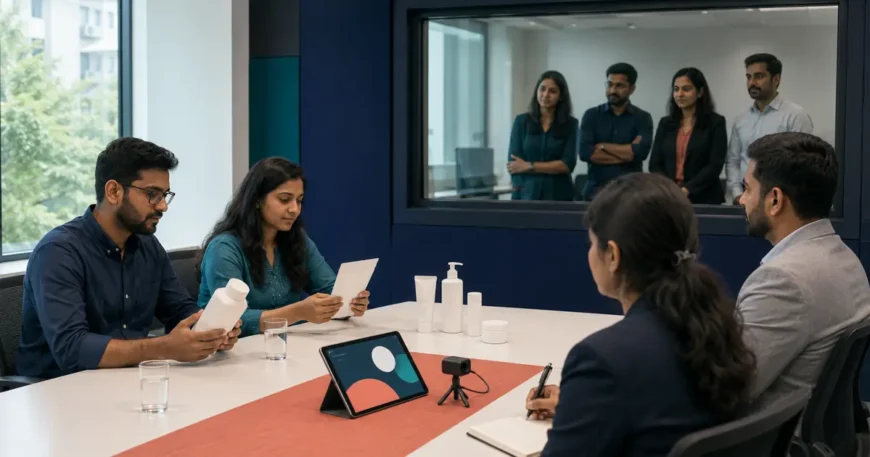
Product testing research in Bangalore should answer a development decision: which concept to advance, what to change, whether performance is acceptable, or whether the product is ready for a larger pilot. Concept tests, central location tests, in-home use tests and usability studies are not interchangeable. Each observes a different part of the product experience.
This guide helps innovation, product, consumer-insight and B2B teams choose the right method, define metrics and avoid the most common interpretation errors.
Which testing method should you use?
Use a concept test before the complete product exists; a CLT when every participant must experience the stimulus under controlled conditions; an IHUT when normal use over time is central; and usability research when you need to observe whether people can complete tasks with a physical or digital interface.
Many development programmes use more than one method, but in sequence: promise first, controlled performance second, real-world fit third.
Start with the product decision not the test format
Before recruiting participants, write the decision in operational terms:
- Select one of three propositions for prototype development
- Identify whether formula A or B performs better on defined sensory attributes
- Decide whether packaging instructions are understood without assistance
- Find the steps that prevent new users from completing an important task
- Determine whether the product fits household routines after seven days of use
Then set the threshold for action. If two concepts score similarly, will qualitative explanation decide? If a usability issue affects a critical task, does one severe failure outweigh a high average score? Pre-agreed rules reduce post-hoc interpretation.
Concept testing: evaluate the promise before full development
A concept test evaluates an idea expressed through a proposition, visual, storyboard, mock-up or early prototype. It can answer whether the intended audience understands the offer, finds it relevant, believes the promise and sees meaningful difference from alternatives.
What to measure
- Clarity and comprehension
- Relevance to a recognised need
- Uniqueness versus current alternatives
- Credibility of the promise
- Perceived value
- Concerns or missing proof
- Behavioural next step, interpreted cautiously
Sequential monadic or comparative?
In a monadic design, each participant sees one concept, reducing direct comparison effects. A sequential monadic design shows several concepts in rotated order, allowing within-person comparison but requiring careful control of fatigue and carryover. A direct comparative task is efficient for preference but may not show whether either concept is strong enough independently.
Choose based on the decision, number of concepts and sample available. Do not make one design answer every question.
Common failure: testing copy rather than the idea
If one concept has polished visuals and another is a rough paragraph, the test confounds design quality with proposition strength. Standardise detail, branding, claim support and visual finish. Record exactly what each participant saw.
Central location testing: control the experience
A central location test brings participants to a venue where product preparation, exposure and measurement can be standardised. It is useful for sensory products, packaging, devices, prototypes and any study where uncontrolled use would make comparison difficult.
ResearchFox’s custom research capability includes participant recruitment and central location, digital, mobile-platform and household testing modes.
What a robust CLT controls
- Sample identity and eligibility
- Product storage and preparation
- Serving or exposure order
- Blind codes and branding conditions
- Time between samples
- Room, lighting, device and facilitator conditions
- Observer access
- Cleaning, reset and data-capture procedures
Rotation and randomisation matter when order could change perception. The operational plan should specify how deviations will be recorded and whether a participant’s data remains usable.
What a CLT can and cannot tell you
A CLT can compare reactions under consistent conditions and support diagnostic probing. It cannot fully reproduce the context, duration, distractions or social setting of normal use. A product that wins a short controlled test may still fail in the home or workplace.
In-home use testing: learn what happens in context
An IHUT places a product with participants to use in their normal environment over a defined period. It is useful when storage, routine, repeat use, household interaction, learning or sustained performance matters.
Strong use cases
- Food, beverage, personal-care and household products used repeatedly
- Devices or appliances that require setup and continued use
- Packaging that must work in kitchens, bathrooms, vehicles or workplaces
- Subscription or replenishment experiences
- Products whose benefit appears over time
Design decisions
Define the use period, minimum usage occasions, instructions, diary or check-in schedule, compliance evidence, replacement process and final evaluation. Decide whether the study is blind, branded or staged. If participants receive different products, manage delivery and coding so the allocation remains traceable.
Common failure: asking only at the end
End-of-test recall hides moments of friction. Use short event-based diaries, photos, videos or mobile check-ins when appropriate and consented. Keep the burden proportionate; an intrusive diary can change the behaviour being observed.
Usability research: observe task performance
Usability testing asks representative users to attempt realistic tasks with a product or interface while researchers observe. It is not a preference contest. A visually liked interface may still prevent task completion.
GOV.UK’s moderated usability-testing guidance defines the method as watching participants try to complete specific tasks and recommends agreeing the research questions, user types and test focus before sessions. Digital products can be tested remotely or in person; physical devices can also be evaluated through task observation in safe, representative conditions.
Useful measures
- Task completion
- Critical errors and recovery
- Time or steps when appropriate
- Need for assistance
- Comprehension of labels and feedback
- Confidence after the task
- Severity and frequency of friction
Ask participants to act, not design
“Where would you click to complete this?” produces stronger evidence than “Do you like this page?” Participants are expert witnesses to their experience, not necessarily product designers. Probe the expectation behind an error before asking for a solution.
How to choose between CLT, IHUT and usability research
Choose a CLT when comparability is the priority
Use it when product handling, preparation or stimulus exposure must be the same for every participant.
Choose an IHUT when context and repeat use are the priority
Use it when routines, environment, other household members, storage or learning affect performance.
Choose usability research when task success is the priority
Use it when the product must enable a person to complete a goal through an interface, instruction sequence or physical interaction.
Combine methods when the risks are different
A concept may be compelling but difficult to use. A product may perform well in a CLT but create storage problems at home. Sequence methods around these distinct risks rather than combining outputs into one undifferentiated “score”.
Our guide to market research methods in Bangalore shows how testing fits with surveys, interviews and focus groups.
Build a testable product scorecard
Create a scorecard before fieldwork with four layers.
1. Decision metric
The small number of measures that determine advance, revise or stop. Examples include critical task success, minimum acceptable performance or a clear concept preference under a defined design.
2. Diagnostic metrics
Attributes that explain the result: taste, texture, perceived efficacy, comprehension, navigation, setup or trust.
3. Behavioural observations
What participants actually do: hesitation, workarounds, errors, skipped instructions, sharing, repeated use or abandonment.
4. Segment and context variables
Prior experience, category usage, role, device, household setting or work environment that may change the result.
Avoid creating so many metrics that the team can choose whichever one supports a preferred concept.
Sampling and recruitment in Bangalore
The sample should reflect intended users, not simply people near the venue. Define category or product experience, frequency of use, brand exclusions, allergies or safety criteria, device ownership, professional role and other factors relevant to the decision.
Bangalore logistics can affect participation. Venue accessibility, working hours, commute time, product-delivery reliability and language should be built into feasibility. For specialist B2B devices or software, verify current role and task responsibility rather than accepting self-description alone.
When claims are intended for a broader Indian market, include locations and groups that represent the intended launch. A Bangalore-only test can be a strong development stage without being treated as a national estimate.
Protect validity with disciplined operations
ISO 20252:2019 sets service requirements for research providers. The MRSI Code and Professional Standards requires responsible, transparent research and highlights responsibilities to data subjects and clients.
For product tests, document:
- Consent and any safety information
- Sample custody, codes and preparation
- Randomisation or rotation
- Moderator and facility instructions
- Product incidents or deviations
- Recording and observer access
- Personal-data handling
- Analysis exclusions decided before results are reviewed
If AI assists with transcript summarisation or coding, keep human review and trace findings back to the underlying evidence.
Turn findings into a development decision
A decision-ready report separates:
- What was tested
- Who participated
- What happened under which conditions
- Which findings meet or miss the threshold
- Why participants reacted that way
- What should change
- What uncertainty remains
Recommendations should point to a design action. “Improve onboarding” is vague. “Move the permission explanation before account linking because four of six target users stopped at that step” is traceable and testable. Small qualitative studies should report the observation without converting it into a population percentage.
ResearchFox’s two-wheeler EV product design testing case shows how product evaluation can connect user evidence with development questions without reducing the study to a preference score.
Conclusion
Concept tests evaluate the promise, CLTs compare controlled performance, IHUTs reveal real-world fit and usability studies expose task friction. The strongest product testing research in Bangalore begins with a decision threshold, recruits intended users, documents the experience and preserves contrary evidence.
Connect with our Bangalore market research experts or share your product-testing brief. ResearchFox can assess the appropriate sequence, recruitment feasibility, facility or remote setup and decision-ready output.
Frequently asked questions
What is product testing research?
It is systematic research that evaluates a product, prototype, concept or experience against defined user and business criteria. It can cover appeal, performance, comprehension, usability, adoption and real-world fit.
What is the difference between concept testing and product testing?
Concept testing evaluates the idea or promise, often before a complete product exists. Product testing evaluates a prototype or usable product and can include performance, sensory, packaging, task or contextual evidence.
What does CLT stand for in market research?
CLT means central location test. Participants attend a controlled venue so researchers can standardise product preparation, exposure, order, equipment and observation.
How long should an IHUT run?
Long enough to capture the intended usage cycle and learning period. A frequently used product may need days; a durable or occasional-use product may need weeks. Define usage occasions rather than selecting a round duration.
Is usability testing only for apps and websites?
No. It can evaluate physical devices, instructions, packaging, kiosks, machinery and service processes whenever people must complete a task through an interface or sequence.
Can a small usability study produce reliable findings?
It can reliably reveal observed problems in the tested users and tasks, but it does not estimate how common each problem is in the full population. Recruit relevant users and prioritise issues by severity and evidence.
Should a product test be blind or branded?
Use blind conditions to isolate product performance; use branded conditions to measure the complete market experience. Some studies use both stages. The design should match the launch decision.


