

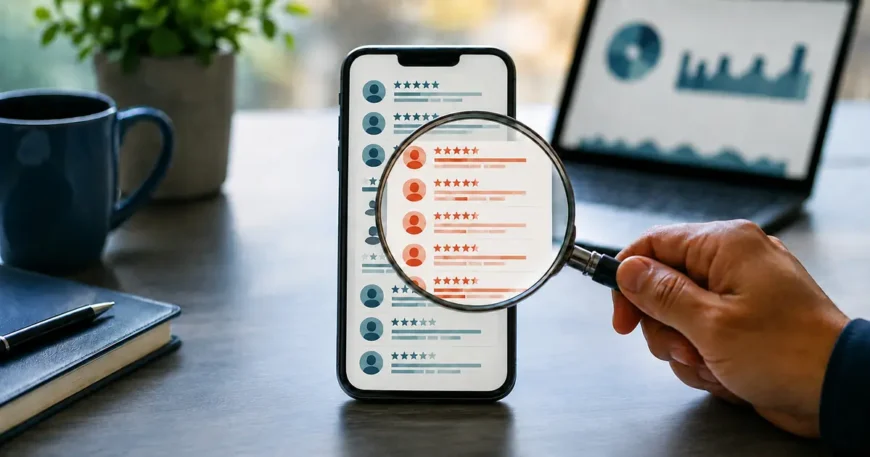
Fake customer reviews are not only a moderation problem. They are a market-research problem because they contaminate a source of consumer evidence, change perceived popularity and make genuine customers less certain about what to trust.
For brands, the right response is not to label every unusual review as fraudulent. It is to combine transaction verification, behavioural signals, qualitative investigation and consumer trust measurement. That approach protects genuine criticism, identifies manipulation risk and shows whether corrective action is rebuilding confidence.
This guide explains how fake reviews affect online shopping, which warning signs deserve investigation and how market research can help a business measure and repair consumer trust.
What is a fake customer review?
A fake customer review is a review that misrepresents the reviewer, the experience or the independence of the opinion. It may be created by a person who never used the product, generated through a coordinated review operation, written by an insider without disclosure or incentivised on the condition that the rating is positive or negative.
Not every inaccurate, emotional or anonymous review is fake. A real customer can remember details incorrectly, post from a different account or express an extreme opinion. Review authenticity therefore should be assessed through multiple signals rather than one phrase, star rating or profile characteristic.
Why fake reviews are a consumer-trust issue
Online reviews reduce uncertainty when buyers cannot inspect a product or service fully before purchase. Manipulated reviews interfere with that function. They can make weak products appear popular, damage an honest competitor or create suspicion around legitimate positive feedback.
A UK government study estimated that 11 to 15 percent of reviews across three product categories on widely used e-commerce platforms were likely fake. It also found that subtle, well-written fake reviews could change purchase behaviour. The study was limited to selected UK platforms and categories, so the figures should not be treated as an India-wide estimate. They do, however, show why surface-level review reading is unreliable.
The business consequence is broader than one lost sale. If consumers believe a review environment is manipulated, they may discount all reviews, rely more heavily on price or familiar brands and become less open to newer businesses. That raises the cost of building credibility for honest sellers.
India’s framework for online consumer reviews
India has developed a standards-based response to online review integrity. The Bureau of Indian Standards framework IS 19000:2022 covers principles and requirements for collecting, moderating and publishing online consumer reviews. A Government of India update describes its guiding principles as integrity, accuracy, privacy, security, transparency, accessibility and responsiveness.
The same government update notes that the standard is voluntary and applies to online platforms that publish consumer reviews. Businesses should confirm the latest legal and certification position with qualified advisers before treating a standard as a mandatory compliance requirement.
For international businesses, the United States Federal Trade Commission’s Consumer Reviews and Testimonials Rule went into effect on 21 October 2024. It addresses practices including fake or false reviews, sentiment-conditioned incentives, certain undisclosed insider reviews, company-controlled review sites presented as independent and review suppression. The rule is US-specific, but it is a useful governance benchmark for global review programmes.
How can a business identify suspicious review activity?
No single indicator proves that a review is fake. A strong review-integrity process looks for combinations of content, timing, account, transaction and network signals.
Review timing and volume
A sudden burst of highly similar ratings after a long quiet period deserves examination. Compare the spike with actual orders, product launches, campaigns, service incidents and requests for feedback. A genuine promotion can also create a review burst, so context is essential.
Reviewer and transaction verification
Where privacy rules and platform access permit, check whether the reviewer can be linked to a real order or service interaction. A verified purchase is a useful signal, but it does not prove that every statement is accurate or independent.
Repeated language and unusual similarity
Coordinated reviews may reuse phrases, structures or product descriptions. Similarity analysis can flag clusters for review, but generic language alone is weak evidence because genuine customers often use common words such as good, fast or helpful.
Rating distribution
Examine changes in the distribution rather than only the average star rating. An abrupt increase in extreme ratings, a missing middle or identical scores across unrelated locations may indicate a process issue. It may also reflect a real service failure or campaign, which should be tested against operational data.
Reviewer networks
The UK government study found that network features, such as reviewers appearing across the same groups of products, were stronger predictors than review text in the studied data. For businesses with access to platform-level information, relationship patterns can therefore be more useful than attempting to identify fraud from wording alone.
Cross-source consistency
Compare review themes with customer support logs, returns, complaints, surveys, social listening and transaction records. If reviews suddenly praise delivery while verified complaints show a major disruption, the inconsistency needs investigation. It is a signal to examine, not automatic proof of deception.
A market research framework for review authenticity
Stage 1: Audit the evidence environment
Map where reviews appear, how each source collects them and which identifiers are available. Document who can solicit, moderate, respond to or remove reviews. Review governance often fails because responsibility is fragmented across e-commerce, marketing, customer service and agencies.
Stage 2: Create a risk-scoring model
Use a transparent combination of signals rather than a secret single rule. Possible indicators include transaction match, review timing, repetition, account history, rating concentration and network overlap. Set thresholds for manual review and keep a record of decisions.
The purpose is triage, not automated accusation. False positives can silence genuine customers and damage trust further.
Stage 3: Measure consumer perception
Run consumer research to understand whether people notice the suspected patterns and how those patterns affect confidence. A survey can quantify awareness and trust. In-depth interviews can reveal how consumers judge credibility, which badges they understand and what makes a brand response feel honest.
A useful study can compare alternative review displays, disclosure language or brand responses. Randomised exposure or A/B concept testing can separate the effect of one design or message from general brand sentiment.
Stage 4: Connect attitude with behaviour
Link survey responses with stated purchase intent, past buying, switching, complaint behaviour or willingness to recommend. Where consent and privacy controls allow, compare research findings with actual conversion, return and retention data.
This prevents the team from treating a trust score as an isolated metric. A small change in stated trust may be commercially important if it affects high-value or first-time customers.
Stage 5: Track trust repair
Repeat a consistent set of measures after governance changes. Track perceived authenticity, confidence in ratings, clarity of disclosures, fairness of moderation and likelihood to use reviews in a future decision. Maintain open-ended questions so unexpected concerns can surface.
How brands can rebuild trust without suppressing criticism
Trust repair begins with making the review process more credible, not making the rating look better.
- Invite Feedback from a broad and relevant customer base
- Avoid Incentives that depend on a positive or negative sentiment
- Disclose Material relationships and sampling programmes clearly
- Preserve Legitimate negative reviews and respond with evidence
- Explain Moderation rules in language customers can understand
- Verify Transactions where feasible without exposing personal data
- Escalate Suspicious clusters for human review
- Publish Corrections when the brand or platform has made an error
Negative reviews can improve credibility when they are genuine and handled well. A brand that acknowledges a problem, explains the remedy and shows what changed may appear more trustworthy than one with an implausibly perfect profile.
What should a consumer-trust study measure?
A practical trust study should cover more than overall satisfaction. It can measure perceived review authenticity, confidence in the platform, clarity of verification labels, fairness of responses, likelihood to purchase, likelihood to recommend and the amount of additional evidence a consumer needs before deciding.
Segment the findings by new and existing customers, category involvement, purchase value, digital confidence and previous exposure to misleading reviews. High-value purchases may require different reassurance from routine purchases.
ResearchFox’s consumer research capabilities can combine surveys, interviews and behavioural context. Our customer experience research can connect review trust with wider journey and service issues. A published e-commerce customer satisfaction study shows how different user groups, support experiences and offers can be assessed together.
Brands can also use digital-footprint research and sentiment analytics to understand where opinions are formed, while recognising that sentiment is not the same as authenticity.
Conclusion
Fake customer reviews threaten consumer trust because they distort evidence at the point of choice. The solution is not a simplistic list of suspicious words. Businesses need governance, transaction context, network and timing signals, consumer research and human judgement.
The strongest approach protects genuine feedback while identifying coordinated risk. It also measures whether customers understand verification, believe moderation is fair and feel confident using reviews again.
If your brand needs to assess review credibility, customer trust or reputation risk, work with a market research company in Bangalore or share your brief with ResearchFox. The study can be designed around the platforms, customer groups and decisions that matter to your business.
Frequently asked questions
How can consumers tell whether an online review is fake?
Consumers cannot prove authenticity from wording alone. Useful checks include verified-purchase status, specific product details, review timing, reviewer history, rating distribution and consistency across independent sources. Several weak signals together are more meaningful than one red flag.
Can fake reviews appear on Trustpilot, Flipkart or other review platforms?
Any platform that accepts user-generated reviews can face attempted manipulation. Platform verification and moderation can reduce risk, but consumers and brands should treat badges, profiles and ratings as evidence signals rather than absolute proof. Research should focus on the specific platform process and available data.
Is every incentivised review fake?
No. A real customer can receive a product sample or incentive and still provide an honest opinion. The key issues include disclosure, independence and whether compensation is conditioned on a positive or negative sentiment. Applicable rules differ by market.
Should a business remove every suspicious negative review?
No. Removing genuine criticism can create legal, ethical and trust risks. Use documented evidence and the platform’s process, distinguish service complaints from manipulation and preserve a fair route for review and appeal.
What is review-authenticity research?
Review-authenticity research combines data audit, behavioural analysis and consumer research to assess manipulation risk and its effect on trust. It can include surveys, interviews, experiments, text analysis, network analysis and comparison with verified transactions or service records.
How often should a brand measure review trust?
High-volume platforms can monitor operational signals continuously and run formal trust tracking at defined intervals. Additional research is useful after a major incident, policy change, acquisition, platform migration or sudden shift in review volume.


