

Summary:
Every successful business strategy begins with solid data, but knowing exactly where to get that data is half the battle. This comprehensive guide by Research Fox clearly explains the difference between primary and secondary research. We provide 10 critical distinctions and real-world examples to help you choose the right data-gathering approach for your market strategy.
Introduction
In 026 and beyond, intuition is no longer a viable business strategy. Whether you are launching a groundbreaking tech startup, introducing a new product line, or simply trying to understand why your competitors are outperforming you, you need hard, indisputable data. However, data does not just magically appear; it must be systematically gathered.
When a company decides to conduct market analysis, they are immediately faced with a foundational choice regarding their methodology. They must understand the difference between primary research and secondary research. Choosing the wrong approach can lead to blown budgets, wasted time, and, worst of all, inaccurate conclusions that can derail an entire product launch.
What is Primary Research?
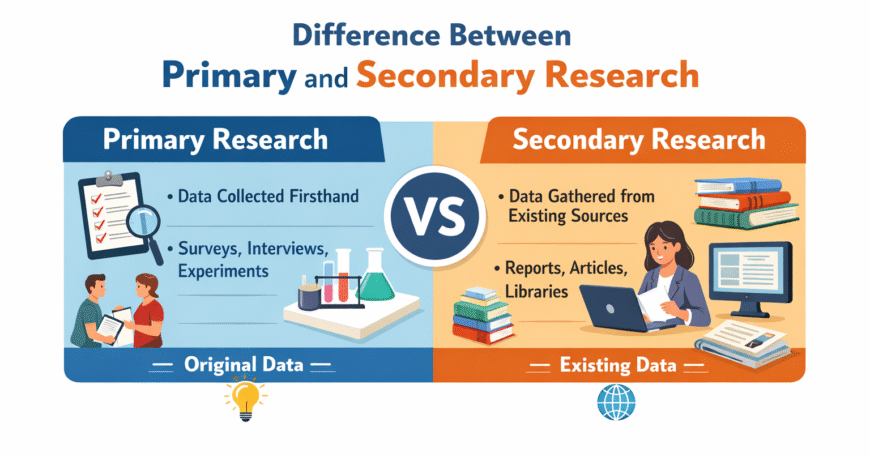
Primary research is the process of gathering fresh, raw, and original data directly from the source. This data did not exist before you collected it. When you conduct primary research, you are actively asking questions, running experiments, and directly engaging with your specific target audience to solve a unique business problem.
Because this research is custom-designed by your company, you dictate exactly what questions are asked and how the information is collected. Common examples of primary research include launching an online survey to your email subscribers, conducting one-on-one interviews with industry experts, hosting consumer focus groups to test a new product prototype, or running A/B tests on your e-commerce website.
What is Secondary Research?
Secondary research, often referred to as “desk research,” involves gathering, analyzing, and synthesizing data that has already been collected and published by someone else. You are taking existing information and applying it to your current business context.
When you use secondary research, you rely on the efforts, budgets, and methodologies of external organizations. The most common sources include government census reports, academic journals, public financial records, competitor websites, industry whitepapers, and commercially published market trend reports. It is the practice of looking at the broader landscape before zooming in on your specific company.
10 Key Differences: Primary vs Secondary Research
To make the best strategic decisions, business leaders must deeply understand the difference between primary and secondary research. Here are the 10 most critical distinctions that separate these two fundamental methodologies.
1. Origin and Source of the Data
The most fundamental difference between primary and secondary sources in research is origin. Primary data is strictly original; it is created entirely by the researcher specifically for the project at hand. Secondary data is pre-existing; it was collected by a third party (like a government agency or another corporation) for a completely different purpose in the past.
2. Purpose and Specificity
Primary research is hyper-specific. If you want to know exactly why 25-year-old women in Mumbai are abandoning their digital shopping carts on your specific website, primary research will give you that exact answer. Secondary research is broad. It might tell you the general e-commerce cart abandonment rates across India, but it will not tell you why it is happening on your specific platform.
3. Time and Effort Required
Gathering primary data is incredibly time-consuming. You must design the study, recruit willing participants, conduct the surveys or interviews, and then clean and analyze the raw data. This can take weeks or months. Secondary research is immediate. With a few clicks, a skilled analyst can download an industry report and begin synthesizing the data within hours.
4. Cost Implications
Because of the heavy logistical effort required, primary research is highly expensive. You must pay for survey platforms, compensate focus group participants, and hire analysts. Secondary research is generally much more cost-effective. Many government and academic sources are entirely free, and even premium syndicated industry reports cost a fraction of what a custom primary study would cost to execute.
5. Level of Control Over Methodology
When examining the difference between primary and secondary research methods, control is a major factor. In primary research, you have 100% control over the methodology. You decide the sample size, the phrasing of the questions, and the demographic of the respondents. In secondary research, you have zero control. You must trust that the original researcher used sound, unbiased methods to collect the data you are now relying on.
6. Recency and Freshness of Data
The difference between primary and secondary data in marketing research is most evident in its recency. Markets change overnight. Primary research gives you real-time data reflecting exactly how consumers feel today. Secondary research is inherently historical. Even a report published just six months ago might be entirely outdated if a new technology or economic shift has disrupted the industry.
7. Ownership and Exclusivity
When you conduct primary research, you own the resulting data. It is proprietary. This gives your business a massive competitive advantage because your rivals do not have access to these exact insights. Secondary research is publicly available. If you can read a broad industry report, your competitors can read that exact same report, meaning it offers no exclusive strategic advantage.
8. Depth of Understanding (Qualitative Insights)
Primary research allows for profound, deep qualitative exploration. If a customer gives an interesting answer in a live interview, the researcher can instantly ask follow-up questions to dig deeper into their emotional motivations. Secondary research is static; you cannot ask a published PDF document to elaborate or clarify a specific statistic.
9. Validation vs. Discovery
Secondary research is best used for broad discovery. It helps you understand the general size of a market, the major economic trends, and the identity of the key competitors. Primary research is best used for validation. Once secondary research has helped you form a hypothesis (e.g., “There is a gap in the market for vegan leather shoes”), you use primary research to validate it (e.g., surveying 1,000 vegans to see if they would actually buy your specific shoe design).
10. Sequential Order of Use
In a proper corporate strategy, the two methods are not mutually exclusive; they are sequential. The golden rule of market intelligence is to always conduct secondary research first. You should exhaust all existing data to build a foundational understanding of the market. Only when the existing secondary data fails to answer your specific, lingering questions should you invest the heavy time and money into primary research.
Pros and Cons of Primary vs Secondary Research
To summarize the operational impact on your business, it is helpful to look directly at the Pros and cons of primary vs secondary research.
Primary Research Pros:
- Data is highly specific and exactly tailored to your business problem.
- Information is current, real-time, and up-to-date.
- The findings are proprietary, offering a distinct competitive edge over rivals.
Primary Research Cons:
- Highly expensive to execute properly.
- Time-consuming, often taking months from planning to final analysis.
- Requires specialized skills to avoid sample bias and leading questions.
Secondary Research Pros:
- Highly cost-effective (often completely free).
- Immediate access to data; can be gathered and analyzed in days.
- Excellent for establishing baselines, market sizing, and identifying broad industry trends.
Secondary Research Cons:
- Information is broad and may not address your specific, niche corporate question.
- Data can quickly become outdated in fast-moving industries like tech or fashion.
- You have no control over the original researcher’s methodology or potential biases.
Real-World Scenarios: Difference Between Primary and Secondary Research Examples
To make these concepts concrete, let’s look at the difference between primary and secondary research examples in a practical B2B and B2C context.
Scenario A (Secondary): The Broad Market Entry A software company is thinking about creating an app for the fitness industry. Before writing any code, they download a massive, commercially available report on “Global Fitness App Usage 2024-2025.” This secondary data tells them the total market size is growing by 15% annually and that yoga apps are currently the most downloaded sub-category. It validates the broad idea that the fitness tech market is a profitable space.
Scenario B (Primary): The Specific Product Launch Now that the company knows the market is viable, they need to know if their specific idea will sell. They build a prototype of a new AI-driven yoga app. They recruit 500 yoga enthusiasts and have them test the app for two weeks. Afterward, they conduct surveys and interviews asking the users to rate the app’s interface and state how much they would be willing to pay for a monthly subscription. This primary data gives them the exact pricing model and feature tweaks needed for a successful launch.
Conclusion
Understanding the difference between primary and secondary research is the bedrock of intelligent business planning. While secondary research provides the necessary wide-angle lens to view the macroeconomic landscape, primary research provides the microscope needed to dissect your specific target audience.
The most successful global brands do not choose between one or the other; they masterfully blend both. They use secondary data to build their foundational knowledge cost-effectively, and they deploy primary research to strike with surgical precision when validating new products.
At Research Fox, we provide end-to-end market intelligence solutions. Stop guessing, start measuring, and let data drive your next big business victory.
Frequently Asked Question:
When should you use primary research instead of secondary research?
You should transition to primary research only after you have completely exhausted all available secondary research. Use primary research when you have a highly specific, unique business question that existing public data cannot answer. For example, secondary research can tell you the average price of a smartphone, but you must use primary research (like a conjoint analysis survey) to determine exactly how much your target audience is willing to pay for the unique new camera feature on your specific smartphone model.
Why is it important to understand the difference between primary and secondary research?
Understanding the difference prevents massive financial waste. If a company does not understand these concepts, it might spend $50,000 conducting primary surveys to find out the demographic makeup of a specific city, information that could be downloaded from a free government census report in five minutes. Conversely, relying solely on broad secondary data to launch a niche product can lead to complete market failure.
How do you know if it is primary or secondary?
Ask yourself one simple question regarding the origin of the data: “Did my team and I collect this raw data directly from the respondents for this exact project?” If the answer is yes, it is primary research. If the data was already collected, published, and existed before you started your project, it is secondary research.
What is primary research?
Primary research is the methodology of gathering original, first-hand data directly from your target audience. It is custom-designed to solve a specific problem and includes methods like focus groups, surveys, interviews, and direct observation.
What is secondary research?
Secondary research (desk research) involves the summary, collation, and synthesis of existing research. It relies on data previously collected by others, such as government records, academic journals, news articles, and commercial industry reports.
What are the advantages of primary and secondary research?
The main advantage of primary research is its absolute specificity and freshness; the data is exactly tailored to your immediate needs and is entirely up-to-date.
The main advantage of secondary research is its speed and cost-efficiency; it allows you to rapidly understand broad market trends without the immense financial and logistical burden of running a custom study.
