

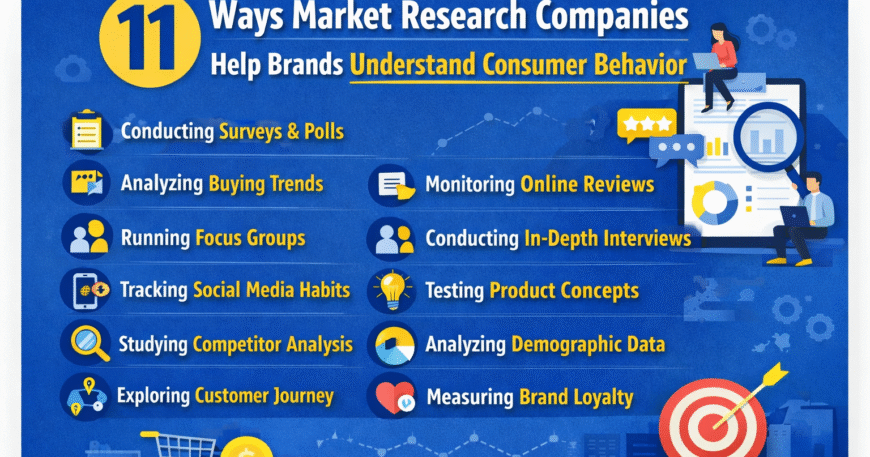
Summary:
Understanding why customers buy is the ultimate competitive advantage. This comprehensive guide explores the 11 key ways the Best market research companies decode buyer psychology. Learn how mastering Consumer behaviour research, leveraging advanced customer insights research methods, and optimizing your Pricing strategy can lead to highly profitable, data-driven business decision making.
Introduction
In 2026, guessing what your customers want is a recipe for business failure. Consumers are bombarded with thousands of marketing messages daily, making their purchasing decisions highly complex, emotional, and sometimes seemingly irrational. To survive and thrive, brands must move beyond mere intuition and adopt rigorous, data-driven business decision making.
This is where the Best market research companies step in. These specialized firms act as a crucial bridge between a brand’s corporate offerings and the consumer’s deep-seated desires. By employing sophisticated psychological frameworks and advanced data analytics, they decode the underlying motivations that drive purchasing habits.
Understanding Market research consumer behaviour is not just about knowing what people buy; it is about understanding why, when, where, and how they buy it. Whether you are a B2C retail brand or a specialized B2B service provider, aligning your strategies with actual consumer psychology is paramount for long-term survival. In this comprehensive guide, we will explore 11 powerful ways market research experts help businesses decipher the enigma of the modern buyer.
1. Demystify the “Why” with Consumer Behavior Analysis
At its core, Consumer behavior analysis is the scientific study of how individuals, groups, or organizations select, secure, use, and dispose of products to satisfy their needs. Market researchers dive deep into the psychological, social, and economic factors that influence these choices. By evaluating a buyer’s demographics (age, gender, income) and psychographics (values, lifestyle, aspirations), research firms create highly detailed and accurate buyer personas. This foundational Consumer behaviour research ensures that a brand understands the exact motivations, daily challenges, and emotional triggers of its target audience, allowing for highly personalized market engagement.
2. Deploy Advanced Customer Insights Research Methods
You simply cannot understand consumer behavior without accurate, high-quality data. The top consumer market research companies utilize a seamless blend of qualitative and quantitative customer insights research methods.
- Quantitative Data: This involves large-scale online surveys, polls, and multiple-choice questionnaires that provide statistically significant numbers, helping brands measure market size, gauge general satisfaction levels, or identify broad buying patterns.
- Qualitative Data: This involves focus groups, one-on-one in-depth interviews, and observational studies (such as watching how a shopper physically navigates a retail aisle). Qualitative methods dig into the emotional reasoning behind a purchase, yielding rich, actionable Consumer insights that numbers alone cannot provide.
3. Optimize the Perfect Pricing Strategy
Price is rarely just a logical number; it is a profound psychological trigger. Consumers associate price heavily with perceived value, quality, and brand prestige. Market research companies conduct specific, targeted studies such as Van Westendorp’s Price Sensitivity Meter or advanced Conjoint Analysis to determine the absolute optimal price point for a product. A well-researched Pricing strategy ensures that a brand does not leave money on the table by pricing too low, nor alienate its core demographic by pricing too high. It helps find that exact “sweet spot” where consumer willingness to pay perfectly aligns with corporate profitability.
4. De-risk Launches Through Product Testing
Launching a brand-new product into the market without prior testing is a massive financial gamble. Research firms help mitigate this high risk through rigorous Product testing. Before a product goes into costly mass production, researchers place prototypes directly into the hands of actual consumers. They carefully monitor how the consumer interacts with the product, what specific features they struggle to use, and what improvements they enthusiastically suggest. This iterative feedback loop ensures that when the product finally hits the shelves, it is already perfectly tailored to meet market demands, drastically reducing the chances of a costly product failure.
5. Analyze the Impact of Branding on Consumer Behaviour
A brand is much more than a catchy logo or a clever slogan; it is the gut feeling a consumer has about a company. The Impact of branding on consumer behaviour cannot be overstated. Research companies meticulously measure brand equity, brand recall, and overall brand sentiment to understand exactly how the public perceives a company. If a brand desperately wants to be seen as an eco-friendly luxury provider, but everyday consumers perceive it as cheap and unsustainable, targeted research will uncover this dangerous disconnect. By identifying these perception gaps, marketers can adjust their public messaging to build authentic trust, foster emotional connections, and drive long-term brand loyalty.
6. Use Powerful Market Trend Analysis Techniques
Consumer behavior is not a static concept; it shifts constantly with cultural changes, economic fluctuations, and rapid technological advancements. What was wildly popular last year might be entirely obsolete today. To keep brands ahead of the curve, researchers employ sophisticated market trend analysis techniques. By analyzing historical sales data, monitoring real-time social media conversations (social listening), and studying macroeconomic indicators, they can accurately predict future shifts in consumer demand. This invaluable foresight allows brands to act as proactive innovators rather than reactive followers.
7. Navigate Complexities with a B2B Market Research Company
While we often think of consumers solely as everyday retail shoppers, businesses are consumers too. However, the B2B buying journey is vastly different and infinitely more complex than B2C. It involves longer sales cycles, multiple board-level stakeholders, and highly logical, ROI-driven decision-making processes. A specialized b2b market research company intimately understands these corporate nuances. They conduct deep-dive, professional interviews with industry decision-makers (like CEOs, CTOs, or Procurement Managers) to understand corporate pain points, tight budget constraints, and strict vendor selection criteria. This helps B2B brands tailor their sales pitches and product suites perfectly to win multi-million dollar contracts.
8. Apply Modern Consumer Behavior Analysis Methods
The modern digital age has introduced a plethora of new, highly technical tools for tracking how users behave online. Modern consumer behavior analysis methods include advanced website analytics (tracking bounce rates and session durations), heat mapping software (seeing exactly where users click or hover on a webpage), and rigorous A/B testing (comparing two variations of a marketing asset to see which performs statistically better). Market researchers expertly interpret this vast ocean of digital data to optimize e-commerce platforms, streamline the digital checkout process, and significantly reduce online shopping cart abandonment rates.
9. Streamline the Market Research Process Guide
A chaotic, poorly planned research initiative yields chaotic, unusable data. Professional research firms provide a highly structured market research process guide to ensure absolute clarity and accuracy. This step-by-step process generally involves:
- Clearly defining the core business problem or specific research objective.
- Identifying and isolating the exact target audience segment.
- Choosing the most appropriate research methodology (surveys, focus groups, observational).
- Collecting the raw data rigorously and ethically.
- Analyzing the data for hidden patterns and statistical significance.
- Presenting clear, actionable recommendations to the brand’s executive team.
By following this strict methodology, research companies ensure that the data collected is completely unbiased, reliable, and directly relevant to the brand’s overarching strategic goals.
10. Map Consumer Behaviour in Marketing
There is often a massive, expensive gap between how corporate marketers assume consumers act and how those consumers actually act in the real world. Consumer behaviour in marketing focuses entirely on closing this gap. Researchers study the “Consumer Decision Journey” the non-linear path a buyer takes from realizing they have a problem, to actively researching solutions, to finally making a purchase, and performing their post-purchase evaluation. By deeply understanding the specific psychological triggers and friction points at every single stage of this journey, marketers can deploy the right message, on the exact right channel, at the perfect time, maximizing their ultimate return on ad spend.
11. Winning Market Share via a Competitive Market Analysis Guide
You simply cannot understand your consumer without intimately understanding the other options available to them. A crucial, non-negotiable part of consumer research is evaluating the competition. Using a comprehensive competitive market analysis guide, top research firms evaluate competitor strengths, glaring weaknesses, product offerings, and public customer reviews. If a competitor’s customers are consistently complaining about poor customer service online, market research will flag this as a golden opportunity. Your brand can then aggressively market its superior customer support to successfully win over those dissatisfied consumers and capture new market share.
The Undeniable Importance of Consumer Behaviour
To summarize, the true Importance of consumer behaviour lies in its unique ability to completely remove the guesswork from high-level business strategy. When a company intimately understands its buyers’ motivations, deep-seated fears, and personal aspirations, it can effortlessly create products that practically sell themselves. The powerful synergy between consumer behaviour and marketing research is the ultimate catalyst for sustainable corporate growth. It transforms raw, cold data into profound human empathy, allowing brands to forge deep, lasting, and highly profitable relationships with their global audience.
Conclusion
In today’s fast-paced market, understanding the “why” behind consumer behavior is no longer optional it is the cornerstone of sustainable business growth. As we have explored, the Best market research companies provide the critical tools needed to navigate this complex landscape. From refining your Pricing strategy to leveraging deep Consumer insights, these expert partnerships completely remove the guesswork from your business model. By embracing robust Consumer behaviour research, brands can proactively anticipate trends, minimize launch risks, and forge deeper, more profitable relationships with their target audience, ensuring long-term success in an ever-shifting global economy.
Contact Research Fox today and let us help you unlock the true potential of your market!
Frequently Asked Questions:
What do market research companies do to understand consumer behavior?
They analyze the psychological, social, and economic factors driving purchases. By studying buying patterns and pain points, they decode consumer motivations to build actionable business strategies.
How do market research companies Collect Data?
They use primary methods like surveys, focus groups, and interviews for direct feedback. Secondary methods include analyzing industry reports, public records, social listening, and website heatmaps.
Why are market research companies important for understanding consumer behavior?
They provide objective, scientific data that eliminates internal corporate bias. This ensures product development, pricing, and marketing strategies are based on real consumer desires, reducing business risk.
Can market research companies help predict consumer trends?
Yes. By using advanced market trend analysis techniques, monitoring macroeconomic indicators, and analyzing real-time social media sentiment, they identify emerging patterns so brands can proactively adapt.
What Are Common Research Methods?
Methods are divided into quantitative (surveys, polls, and A/B testing) for measurable numerical data, and qualitative (focus groups, one-on-one interviews, and observation) to explore emotional reasoning.
How do market research companies help improve product development?
They conduct rigorous product testing. Researchers gather target audience feedback on prototypes before mass production, ensuring the final product meets market needs perfectly and reducing launch failures.
How do market research companies help brands create better marketing strategies?
By mapping the consumer decision journey. They identify where audiences spend time and what messaging resonates emotionally, allowing brands to launch highly targeted, cost-effective advertising campaigns.
Which market research company offers the best customer insights tools?
It depends on your specific needs. Nielsen IQ leads in retail data. For digital surveys, Qualtrics, SurveyMonkey, and Pollfish are excellent. Boutique firms excel at customized qualitative research.
Why do some companies choose to outsource marketing research activities?
Outsourcing provides an unbiased perspective, specialized expertise, advanced data tools, and access to massive consumer panels. It is much faster and more cost-effective than building an in-house team.
A company manufactures two products. How does market research help?
Market research helps a multi-product company determine optimal pricing for each item, identify which specific audience prefers which product, and allocate marketing budgets effectively to avoid product cannibalization.

