

Summary:
Entering a new market or launching a product without data is a recipe for failure. To thrive in today’s hyper-competitive landscape, companies must rely on hard facts rather than intuition. This comprehensive guide by ResearchFox explores the ultimate market research and competitive analysis process. Discover 10 actionable steps, powerful digital market research tools, and advanced competitor analysis strategies to outsmart your rivals, minimize business risks, and capture a larger share of your target audience.
Introduction
In the modern business environment, a brilliant idea is simply not enough to guarantee success. Whether you are an established enterprise looking to expand or an entrepreneur preparing for a launch, the market is crowded, noisy, and unforgiving. To cut through the noise and capture your target audience’s attention, you must possess a deep, granular understanding of both your customers and your rivals.
This is where a robust market research and competitive analysis process becomes the most valuable asset in your corporate toolkit.
Far too many companies launch products based on internal assumptions. They guess what their customers want and assume they know what their competitors are doing. However, assumptions do not generate revenue; data does. By undertaking thorough business market research and competitive analysis, you replace dangerous guesswork with strategic certainty. You learn exactly where market gaps exist, what pricing models work, and how you can position your brand to win.
The Importance of Market Research and Competitive Analysis
Why should a company dedicate significant time and budget to studying the market? The importance of market research and competitive analysis cannot be overstated. It serves as the foundation for every successful marketing, sales, and product development strategy.
First, it acts as a risk mitigation tool. Before you invest millions of dollars into manufacturing a new product or expanding into a new geographic territory, research tells you if a viable demand actually exists. Second, it provides a benchmark. You cannot confidently claim your product is “the best” or “the most affordable” unless you know exactly what your competitors are offering. Finally, it drives innovation. By identifying the pain points that your competitors are failing to solve, you can engineer solutions that perfectly address the unmet needs of the market.
10 Steps to Perform Effective Market Research and Competitive Analysis
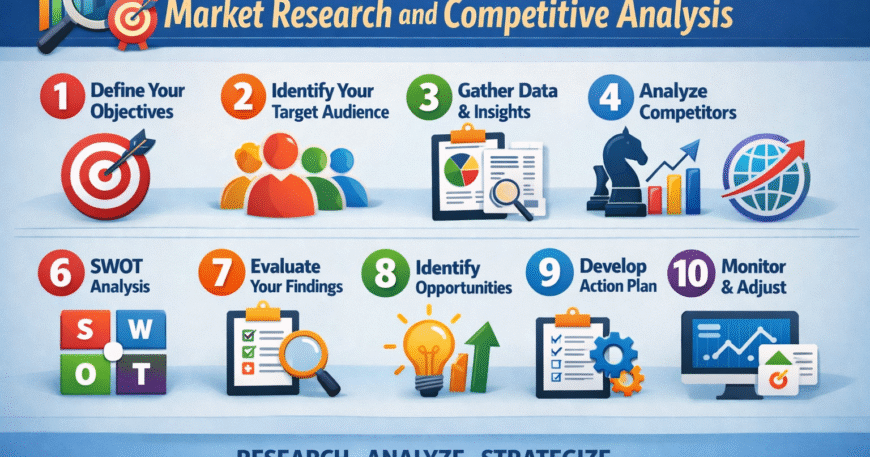
Executing this research requires a structured, methodical approach. Here are the 10 essential steps to guide your strategy from initial planning to final execution.
Step 1: Define Your Core Objective and Scope
Before you collect a single piece of data, you must know what you are looking for. Are you trying to determine the optimal price for a new software product? Are you trying to understand why your main competitor is getting more website traffic? Defining a clear, singular objective prevents you from getting lost in a sea of irrelevant data. Your objective will dictate the specific market research and competitive analysis methods you choose to deploy.
Step 2: Identify and Segment Your Target Audience
You cannot research a market if you do not know who comprises it. Define your ideal buyer personas. Look beyond basic demographics like age and location; delve into psychographics. What are their daily frustrations? What motivates their purchasing decisions? Where do they consume their information? The more precisely you can define your audience, the more accurate your subsequent research will be.
Step 3: Choose the Right Market Research and Competitive Analysis Methods
Research is generally divided into two categories: primary and secondary. Primary research involves gathering new, original data directly from your target audience through surveys, focus groups, and one-on-one interviews. Secondary research involves analyzing existing data, such as industry reports, census data, and academic studies. A successful strategy will utilize a blend of both qualitative methods (to understand the “why”) and quantitative methods (to measure the “how many”).
Step 4: Identify Your Direct and Indirect Competitors
If you want to know how to analyze competitors in business, you must first categorize them accurately. Direct competitors are businesses that offer the exact same product or service to the exact same audience (e.g., Coca-Cola vs. Pepsi). Indirect competitors offer different products that solve the same underlying problem (e.g., a local gym vs. an at-home fitness app). Map out both categories, as indirect competitors can quickly pivot to become direct threats.
Step 5: Leverage Digital Market Research Tools
In the digital age, you do not have to conduct research manually. Utilizing advanced digital market research tools is essential for gathering vast amounts of data quickly. Tools like SEMrush or Ahrefs allow you to see exactly which keywords your competitors are ranking for and where their website traffic comes from. Platforms like Qualtrics or SurveyMonkey are perfect for deploying rapid consumer surveys, while social listening tools like Mention can track what customers are saying about your rivals in real-time.
Step 6: Execute Deep Competitor Analysis Strategies
Once you have identified your rivals and gathered your tools, it is time to dissect their business models. Effective competitor analysis strategies involve analyzing their product features, their pricing tiers, and their customer service reviews. Subscribe to their email newsletters, buy their products, and navigate their sales funnels. By experiencing their brand exactly as a customer would, you can easily identify friction points and areas where your company can offer a superior experience.
Step 7: Analyze Competitor Marketing and Positioning
How do your competitors speak to the market? Look at their content marketing, social media presence, and advertising campaigns. Are they positioning themselves as the premium, luxury option, or the budget-friendly alternative? Understanding their brand positioning allows you to carve out a unique space for your own company, ensuring your messaging stands out rather than blending into the background.
Step 8: Conduct a Comprehensive SWOT Analysis
Take all the data you have gathered about the market and your competitors and organize it into a SWOT matrix: Strengths, Weaknesses, Opportunities, and Threats.
- Strengths: What do your competitors do exceptionally well?
- Weaknesses: Where are they failing their customers?
- Opportunities: What emerging market trends are they currently ignoring?
- Threats: What external factors (like new regulations or economic shifts) could harm your industry?
Step 9: Review Market Research and Competitive Analysis Examples
Do not reinvent the wheel. Look at historical market research and competitive analysis examples within your industry. How did a major brand successfully launch a counter-attack against a rising competitor? How did a company fail because it misread market demand? Studying past case studies provides invaluable context and can help you avoid making expensive historical mistakes.
Step 10: Synthesize Data and Formulate Your Strategy
Data is useless unless it is transformed into action. Compile your findings into a clear, executive-level report. Use the insights to make definitive business decisions. If your research showed that customers hate your competitor’s confusing pricing structure, formulate a marketing campaign highlighting your own brand’s transparent, flat-rate pricing. Every piece of data should directly inform a specific tactic in your upcoming business strategy.
Market Research and Competitive Analysis for Startup Companies
While massive corporations have dedicated departments for this, market research and competitive analysis for startup companies is arguably even more critical. Startups operate with limited runways and highly restricted budgets; they simply cannot afford to launch a product that nobody wants.
For a startup, research is the key to securing funding. Venture capitalists and angel investors will not fund a “good idea.” They fund businesses that can mathematically prove there is a gap in the market and demonstrate exactly how they will capture market share from existing incumbents. Startups should focus heavily on primary research getting out of the building and talking directly to potential early adopters to validate their Minimum Viable Product (MVP) before writing a single line of code or manufacturing a prototype.
Conclusion:
Mastering the market research and competitive analysis process is the ultimate differentiator between businesses that merely survive and those that dominate. By following these 10 steps, leveraging modern digital market research tools, and deeply understanding your rivals’ weaknesses, you can build a resilient, agile, and highly profitable brand.
At ResearchFox, we understand that gathering and interpreting this level of data can be daunting. You do not have to navigate the market alone. Our team of expert analysts specializes in delivering deep, actionable insights that completely eliminate the guesswork from your strategic planning.
Whether you need an in-depth analysis of a global market or tailored competitor analysis strategies for your specific niche, Research Fox is your dedicated partner in growth. Contact us today to learn how our research solutions can propel your business forward.
Frequently Asked Questions:
What do you mean by market research?
Market research is the systematic process of gathering, analyzing, and interpreting information about a specific target market, consumers, and the industry at large. It involves studying consumer behavior, economic trends, and purchasing habits to determine the viability of a new product or service.
How to explain market research?
Think of market research as a compass for a business. Instead of walking blindly into a forest and hoping to find a path, market research provides a detailed map. It tells a company exactly who wants to buy their product, how much they are willing to pay, and where they prefer to shop, ensuring the business moves in the right, profitable direction.
What is the 3-3-3 rule in marketing?
While variations exist, the 3-3-3 rule in modern content and digital marketing generally refers to capturing audience attention: you have 3 seconds to hook the viewer (grab attention), 30 seconds to explain your core value proposition (engage), and 3 minutes to provide deep information and close the sale or call-to-action.
What is the golden rule of marketing?
The golden rule of marketing is simple: “Know thy customer.” Every successful marketing campaign, product design, and sales pitch must be deeply rooted in a profound understanding of the customer’s needs, desires, and pain points. You must always prioritize solving the customer’s problem over merely pushing your product.
Why is market research and competitive analysis important for businesses?
It is vital because it eliminates guesswork. It mitigates financial risk by proving market demand before production begins, helps businesses identify profitable gaps left by competitors, and provides the hard data necessary to create highly targeted, cost-effective marketing and sales strategies.
What are the key steps in market research and competitive analysis?
The key steps include defining your core objective, identifying your exact target audience, categorizing your direct and indirect competitors, gathering both primary and secondary data, analyzing competitor marketing and pricing, conducting a SWOT analysis, and synthesizing the findings into an actionable business strategy.
How do you conduct market research and competitive analysis effectively?
Effective research requires a blend of both qualitative data (interviews and focus groups to understand emotions) and quantitative data (large-scale surveys for statistical facts). It also requires remaining objective; you must analyze the data honestly, even if it contradicts your initial business assumptions or ideas.
What tools are used for market research and competitive analysis?
Businesses rely on a variety of digital market research tools. For SEO and web traffic analysis, tools like SEMrush, Ahrefs, and SimilarWeb are industry standards. For consumer surveys, SurveyMonkey and Qualtrics are highly effective. For social listening and brand monitoring, tools like Mention, Hootsuite, and BuzzSumo provide real-time insights into market sentiment.


