

Summary:
In the competitive industrial manufacturing industry, data is the new oil. This guide by Research Fox outlines the 12 critical metrics every manufacturer needs to track to optimize production, understand customer needs, and outpace competitors. Learn how to leverage manufacturing analytics market research to drive strategic decision-making.
The industrial manufacturing industry is undergoing a profound transformation. We have moved past the age where efficiency was solely about the speed of the assembly line or the durability of raw materials. Today, efficiency is about information. In an era defined by Industry 4.0, global supply chain volatility, and rapidly shifting B2B buyer behaviors, the manufacturers who win are not just those with the best products, but those with the best data.
However, having data is not the same as having insight. Many manufacturers are drowning in operational data production rates, downtime logs, and inventory turnover, but they often lack the external intelligence needed to contextualize their position in the market. This is where market research manufacturing becomes the linchpin of strategy.
At ResearchFox, we have observed that successful industrial giants do not just track internal KPIs; they obsessively monitor market-facing metrics. They use manufacturing analytics market research to bridge the gap between their factory floor and the end-user. In this extensive guide, we will explore the 12 critical metrics that every manufacturing business should track.
The New Era of Manufacturing Intelligence
Historically, market research was often seen as a tool for consumer goods (B2C) focus groups tasting new sodas or surveys about shampoo packaging. In the B2B manufacturing world, relationships were built on handshakes and golf courses. But that landscape has shifted.
Today’s B2B buyers are digital-first. They research online, compare specifications instantly, and demand a level of personalization and responsiveness that traditional sales models cannot deliver alone. To navigate this, manufacturers need a customer research report that goes beyond “who bought what.” They need to understand why they bought it, how they are using it, and what they will need five years from now.
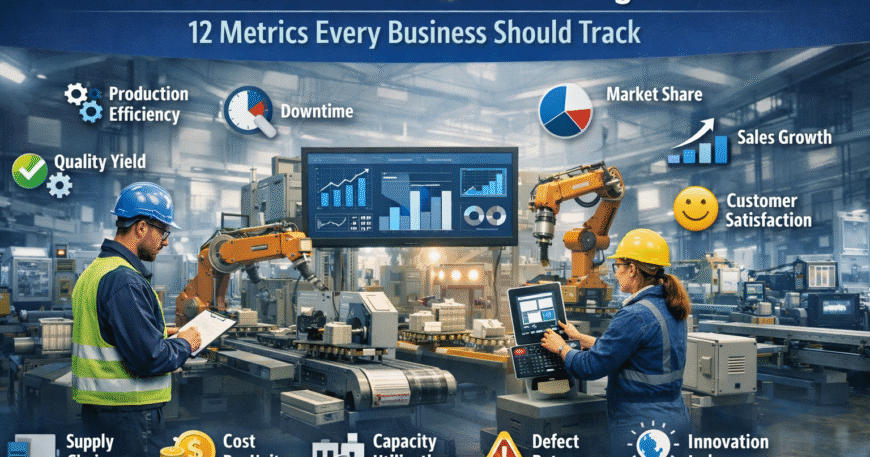
12 Metrics Every Manufacturing Business Should Track
To move from reactive fire-fighting to proactive strategy, you need to monitor the right indicators. We have categorized these into three strategic pillars: Market Performance, Customer Health, and Brand Strength.
Pillar 1: Market Performance Metrics
These metrics tell you where you stand relative to the competition and the market opportunity.
1. Market Share (Volume and Value)
This is the grandfather of all metrics, yet often misunderstood. It is not enough to know your revenue is growing; you must know if you are capturing a larger slice of the pie. Industrial market research companies can help you calculate your share by volume (units sold) and value (revenue generated), revealing if you are losing ground to cheaper competitors or premium alternatives.
2. Total Addressable Market (TAM) Penetration
Do you know the theoretical limit of your growth? TAM represents the total revenue opportunity available if 100% of the market bought your product. Tracking your penetration rate against the TAM helps you set realistic growth targets and identify untapped geographical or sectoral segments.
3. Competitive Win/Loss Rate
When you lose a bid for a contract, do you know why? Was it price, lead time, technical specs, or relationship? Tracking the Win/Loss rate and, critically, the reasons behind it is a vital piece of market research manufacturing intelligence. It highlights exactly where your value proposition is failing.
4. Share of Wallet (SOW)
In B2B manufacturing, your existing customers often buy from multiple vendors. SOW measures the percentage of a customer’s total spend in your category that goes to you. Increasing SOW is often cheaper and easier than acquiring new customers, but it requires deep insight into their procurement habits.
Pillar 2: Customer Health Metrics
The industrial manufacturing industry thrives on long-term contracts. These metrics ensure those relationships remain profitable.
5. Net Promoter Score (NPS)
While often associated with consumer brands, NPS is crucial in B2B. It asks one simple question: “How likely are you to recommend us to a colleague?” A high NPS in manufacturing correlates strongly with contract renewals. Tracking this helps you identify “detractors” before they switch suppliers.
6. Customer Acquisition Cost (CAC)
How much does it cost to land a new industrial client? This includes marketing spend, sales team salaries, and trade show costs. By tracking CAC alongside Customer Lifetime Value (CLV), you can determine if your sales strategy is sustainable.
7. Customer Satisfaction (CSAT) with Technical Support
In manufacturing, the product is only half the battle. Post-sales support, installation, maintenance, and troubleshooting is often where loyalty is won or lost. Measuring CSAT specifically for your technical support team identifies gaps in training or service speed.
8. Product Usage Rate / Adoption Rate
For manufacturers of machinery or components, knowing how the customer uses the product is key. Are they utilizing all the features of your new CNC machine, or just the basics? Low adoption rates of advanced features are a leading indicator of churn or a sign that your R&D is misaligned with user needs.
Pillar 3: Brand & Innovation Metrics
These metrics measure your reputation and future viability.
9. Brand Awareness and Recall
In a niche industrial sector, everyone claims to be the “market leader.” But when a procurement manager thinks of “industrial pumps,” do they think of you first? Market research firms use unaided recall surveys to measure how top-of-mind your brand truly is.
10. Innovation Success Rate
Manufacturing thrives on R&D. But how many of your new products actually succeed? This metric tracks the percentage of revenue generated by products launched in the last 3 years. A low rate suggests a disconnect between your R&D lab and the market reality.
11. Lead Quality Score
Not all leads are created equal. In B2B, a lead from a student downloading a whitepaper is worth far less than a lead from a CTO requesting a quote. Scoring leads based on firmographic data ensures your sales team focuses on high-value targets.
12. Supply Chain Resilience Score
While often an operational metric, market research plays a role here by assessing supplier risk. Monitoring the financial health and market stability of your suppliers ensures you don’t face upstream disruptions.
How to Conduct Industrial Market Research?
Conducting research in the B2B space is fundamentally different from consumer research. You cannot just stand in a mall with a clipboard. It requires access to decision-makers, technical understanding, and specialized market research methodologies.
Here is a step-by-step framework used by experts at ResearchFox:
Step 1: Define the Problem, Not Just the Topic
Do not just say, “We need research.” Define the business problem. “Sales of our X-Series turbine are down 15% despite a market upturn. Why?” The more specific the question, the more actionable the answer.
Step 2: Choose the Right Methodology
- Expert Interviews (IDIs): In manufacturing, depth matters more than breadth. Interviewing 10 Procurement Heads or Plant Managers can yield more insight than surveying 1,000 random people.
- Secondary Research: Leverage trade journals, patent filings, and competitor annual reports. Industrial market research companies excel at mining these sources for hidden gems.
- Observational Research: Sometimes, you need to visit the factory floor to see how your product is actually installed or used.
Step 3: Segment Your Market
The industrial manufacturing industry is not monolithic. Segment your audience by:
- Firmographics: Company size, revenue, location.
- Application: How they use your product (e.g., OEM vs. Aftermarket).
- Decision-Making Unit: Are you talking to the Engineer (technical fit) or the CFO (price)?
Step 4: Data Collection and Analysis
This is the hardest part in B2B. Reaching a VP of Operations requires persistence and professional recruitment. Once data is collected, use manufacturing analytics market research tools to look for correlations. For example, does a lower NPS score correlate with clients who bought a specific product line?
Step 5: Turn Insights into Action
A customer research report is useless if it sits on a shelf. Translate findings into strategy. If research shows customers value “speed of delivery” over “price,” stop discounting and start investing in local warehousing.
The Role of Research Fox
Why should a manufacturer partner with ResearchFox instead of doing this in-house?
- Access to Hard-to-Reach Audiences: We have established panels of industry experts, from plant managers to procurement directors, across various industrial sectors.
- Objectivity: An internal team might be biased towards their own products. We provide an unvarnished, third-party view of where you stand in the market.
- Methodological Expertise: We blend quantitative data with qualitative insights. We don’t just tell you what the market share is; we tell you why it is changing.
- Advanced Analytics: We utilize cutting-edge tools to analyze complex B2B data sets, identifying trends that are invisible to the naked eye.
Conclusion
In the high-stakes world of the industrial manufacturing industry, intuition is a dangerous compass. The cost of a strategic misstep, building a factory for a product nobody wants, or ignoring a competitor who is undercutting you, is simply too high.
Market research manufacturing is not an expense; it is an investment in certainty. It provides the clarity you need to navigate supply chain shocks, changing buyer demands, and technological disruption.
Whether you need a deep-dive customer research report or a continuous tracker for your brand health, ResearchFox is your partner in industrial intelligence. Let us help you turn data into dominance.
Ready to optimize your manufacturing strategy? Contact ResearchFox today.
Frequently asked Questions:
Why is market research difficult in the manufacturing sector?
Unlike B2C, the sample sizes in manufacturing are smaller, and the decision-makers (engineers, procurement heads) are harder to reach. It requires specialized recruitment and technical knowledge that general research agencies often lack.
What is the difference between industrial and consumer market research?
Consumer research focuses on personal preferences and emotional drivers of millions of individuals. Industrial market research companies focus on rational drivers (ROI, specs, efficiency) of complex organizations with long sales cycles.
How often should we update our customer research report?
For fast-moving sectors, an annual deep dive is recommended, with quarterly “pulse” checks on key metrics like NPS and Win/Loss rates to catch trends early.
Can market research help with supply chain issues?
Yes. Research can assess the stability of your upstream suppliers and identify alternative sourcing markets, helping you build a more resilient supply chain resilience score.
What is the most important metric for a B2B manufacturer?
While all are important, Customer Lifetime Value (CLV) combined with Share of Wallet is critical. In manufacturing, retaining and growing a high-value account is far more profitable than constantly hunting for new, smaller clients.


