

Summary:
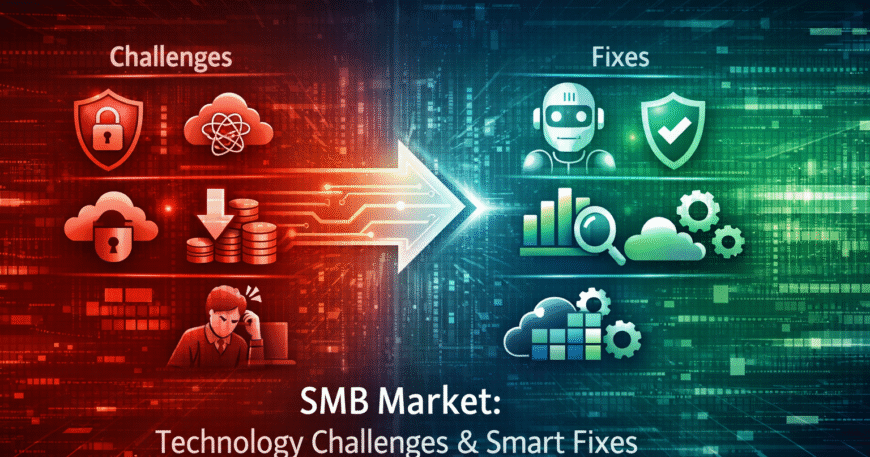
Small and Midsize Businesses (SMBs) are the engine of the global economy, yet they face unique hurdles when adopting new tech. This guide by Research Fox explores the top 10 SMB MARKET technology challenges in 2026. From managing a tight SMB IT budget to navigating small business cloud adoption, we provide actionable fixes and highlight the best IT solutions for SMBs to drive growth and efficiency.
Introduction
The Small and Midsize Business (SMB) sector is incredibly dynamic, serving as the backbone of the global economy. However, as enterprise-level technology becomes the standard for consumer expectations, SMBs are feeling the pressure to modernize rapidly. Understanding the SMB MARKET technology challenges is no longer just an IT issue; it is a fundamental business survival imperative.
While massive corporations have dedicated departments and seemingly endless budgets to test new software, SMBs must be highly strategic. A wrong technological investment can cripple cash flow, while the right one can catapult a local business into a global player. Whether a company is looking at a complete SMB digital transformation or just trying to figure out how to secure small business IT against modern threats, the path is often filled with obstacles.
SMB Marketing: Overcoming Challenges and Embracing Opportunities
Before diving into the pure IT challenges, we must address how technology impacts the revenue engine of any business: marketing. SMB Marketing: Overcoming Challenges and Embracing Opportunities requires a deep understanding of data. Today, marketing is fundamentally a technological discipline.
The challenge for SMBs is that consumer data is often scattered across different platforms social media, email marketing tools, and rudimentary customer databases. This fragmentation makes it nearly impossible to build a cohesive customer journey. When SMBs attempt to adopt advanced marketing automation tools, they often hit a wall of technical complexity.
However, the opportunities are massive. By utilizing the leading platforms for smb growth and digital transformation such as integrated CRMs (Customer Relationship Management systems) SMBs can automate their lead nurturing, segment their audiences with precision, and deliver hyper-personalized campaigns that rival those of Fortune 500 companies. The key is to start small, integrate systems step-by-step, and ensure that every piece of marketing technology directly supports a clear sales objective.
Top 10 Challenges For SMBs and How to Solve Them
Navigating the modern tech landscape requires patience and strategy. Here are the top 10 small business technology challenges we see in the market today, along with proven fixes to overcome them.
1. The Constraints of a Limited SMB IT Budget
The Challenge: Unlike massive enterprises, small businesses operate on razor-thin margins. A restricted SMB IT budget is consistently cited as the number one barrier to upgrading systems, buying new hardware, or hiring top-tier tech talent.
The Fix: Shift from a Capital Expenditure (CapEx) model to an Operating Expenditure (OpEx) model. Instead of buying expensive servers upfront, invest in subscription-based Software-as-a-Service (SaaS) tools. This turns large, unpredictable IT costs into manageable monthly expenses, allowing you to scale up or down as your cash flow permits.
2. Navigating Small Business Cloud Adoption
The Challenge: While the cloud offers immense flexibility, small business cloud adoption is often stalled by fears of data loss, confusing pricing tiers, and the sheer technical complexity of moving existing files from local servers to cloud networks like AWS or Azure.
The Fix: Do not attempt a “lift and shift” of all your data overnight. Adopt a hybrid approach. Start by migrating non-critical systems, such as employee email and collaborative documents (using Google Workspace or Microsoft 365). Once your team is comfortable, gradually migrate heavier databases and proprietary applications.
3. Escalating Cybersecurity Threats
The Challenge: Hackers no longer just target big banks; they increasingly target SMBs because they know small businesses have weaker defenses. Ransomware and phishing attacks are massive SMB IT challenges that can bankrupt a small company in days.
The Fix: Figuring out how to secure small business IT doesn’t require a million-dollar budget. Start with the non-negotiables: enforce Multi-Factor Authentication (MFA) across all company accounts, implement automated daily data backups stored off-site, and conduct regular cybersecurity awareness training for all employees to prevent human error.
4. Overcoming SMB Software Adoption Challenges
The Challenge: You buy a shiny new project management tool, but your team refuses to use it, clinging to their old spreadsheets. SMB software adoption challenges usually stem from a lack of training and the natural human resistance to change.
The Fix: Involve your team in the purchasing decision. If they help choose the software, they are more likely to use it. Furthermore, identify an internal “tech champion” an enthusiastic employee who can learn the system deeply and act as a peer-to-peer trainer for the rest of the staff.
5. Achieving Genuine SMB Digital Transformation
The Challenge: Many businesses mistake “going paperless” for transformation. True Digital transformations SMB leaders aim for involves completely rewiring how the business delivers value to the customer, which requires a massive cultural shift.
The Fix: Follow the best practices for smb growth and digital transformation by starting with the customer experience. Ask: “How can technology make it easier for our customers to buy from us?” If a new technology does not directly improve the customer journey or drastically cut operational friction, do not invest in it.
6. The Burden of Legacy Systems
The Challenge: Many established SMBs are running on software that is 10 or 15 years old. These legacy systems are slow, incompatible with modern mobile apps, and represent severe security risks because they no longer receive developer updates.
The Fix: Conduct a comprehensive tech audit. Identify which legacy systems are holding the business back. Use middleware (software that acts as a bridge) to connect old databases to modern front-end tools temporarily, while you slowly phase out the outdated infrastructure over a 12-to-18-month roadmap.
7. Integrating Disparate Tools
The Challenge: A company uses one app for billing, another for marketing, and a third for customer support. These systems do not “talk” to each other, resulting in data silos and employees wasting hours manually copying and pasting information between tabs.
The Fix: Prioritize integration when shopping for the best IT solutions for SMBs. Look for platforms that have native integrations or open APIs. Utilizing automation tools like Zapier or Make can seamlessly connect different apps, ensuring data flows automatically across your entire tech stack.
8. The IT Talent Shortage
The Challenge: Small businesses simply cannot afford to match the six-figure salaries that massive tech companies pay for network engineers and cybersecurity experts, leaving them without dedicated in-house IT support.
The Fix: Outsource to a Managed Service Provider (MSP). For a predictable monthly fee, an MSP acts as your entire off-site IT department. They monitor your networks 24/7, handle software updates, and provide help-desk support, giving you enterprise-level expertise at a fraction of the cost.
9. Lack of a Strategic IT Roadmap
The Challenge: Too many SMBs buy technology reactively fixing a server only when it breaks or buying a new app only when a specific crisis occurs. This leads to a chaotic, bloated, and highly inefficient technological environment.
The Fix: Treat IT as a strategic partner, not a utility. Company leaders must sit down annually to map out the top SMB technology priorities 2026. If the business goal is to expand into a new region, the IT roadmap must reflect the infrastructure needed to support remote workers in that area.
10. Keeping Pace with AI and Automation
The Challenge: The rapid rise of Artificial Intelligence is intimidating. SMBs know they need to leverage AI to stay competitive, but they often don’t know where to start, fearing it is too complex or expensive.
The Fix: You do not need to build your own AI. Leverage the AI that is already built into the tools you use. Use AI-driven features in your CRM to score sales leads, use AI writing assistants to draft standard emails, and deploy AI chatbots on your website to handle basic customer FAQs after hours.
Conclusion
Understanding the SMB MARKET technology challenges is the first critical step toward overcoming them. Technology should be a massive lever for growth, not a constant source of stress. By carefully managing your SMB IT budget, taking a phased approach to small business cloud adoption, and prioritizing robust cybersecurity, your company can build a resilient, scalable foundation.
At Research Fox, we know that the most successful companies are those that make decisions based on clear market realities, not guesswork. By following these best practices for smb growth and digital transformation, you can confidently navigate the complexities of 2026. Stop fighting your technology and start making it work for your bottom line.
FAQs
What are the biggest technology challenges faced by SMBs?
The most significant challenges include operating with a highly restricted IT budget, defending against sophisticated cybersecurity threats, integrating various disjointed software tools, and managing the cultural resistance that comes with adopting new technologies.
How can SMBs improve cybersecurity on a small budget?
You can drastically improve security without spending a fortune by enforcing Multi-Factor Authentication (MFA) on all logins, keeping all software updated automatically, utilizing secure cloud backups, and regularly training employees to spot common phishing emails.
Which technologies should SMBs prioritize for growth?
SMBs should prioritize Customer Relationship Management (CRM) software to centralize sales data, cloud-based collaboration tools (like Slack or Microsoft Teams) to enhance team productivity, and automated marketing tools to scale their customer outreach efforts efficiently.
What are common cloud adoption problems for SMBs and how to avoid them?
Common problems include unexpected hidden costs, data migration errors, and employee confusion. To avoid these, SMBs should thoroughly calculate costs using cloud pricing calculators, start by migrating non-essential data first as a test, and provide comprehensive training to staff before the full rollout.
